Showing posts with label astronomy. Show all posts

Friday, August 19, 2011

Young Lovecraft and Astronomy

For this post, Chrispy will cast modesty aside. In earlier posts, Chrispy uncovered nearly the exact dates that Lovecraft almost died early in 1910. This was based on an obscure and sudden comet appearance, Comet 1910A.

He lost a great deal of weight, likely due to complications from measles and lung infection. He made a slow recovery, but was feeling well enough by the time of Halley's comet to go out at night by trolley and view it with his telescope and sketch it. With the help of several friends, mainly Steve and Dave, the precise point where he did his sketches was determined.

The articles below show the hysteria over Halley's comet which only phased Lovecraft in that he would have been appalled by what he would call ignorance. Note the "Comet pills" in the article below.

He went back and forth on Percival Lowell and his theory. This parallels public articles. Lowell was a powerful, popular figure and astronomers did not cross him lightly. However, as new telescopes went on line, Lowell's power faded, and astronomers were more vocal. This echoes the articles Lovecraft did in newspapers, as he mostly responded to the breaking news of astronomy.

What is becoming clear is that Lovecraft adored astronomy, but somehow he had a disconnect. He was a reasonably good observer, and a reasonably good writer conveying astronomical knowledge, but he did not become a good theoretician. Even with all the data he accumulated from hours of observations, Chrispy has not yet detected one original theory has been found in his writing - not even a bad one.

(His presentation of the theory of a ninth planet was bold, but it was a belief that many held based on a number of theories of the time. Lovecraft poeticized his Yuggoth, his near-contemporary Clyde Tombaugh searched for it.)

Can one fault his telescope? Not really. He read copious articles in professional and amateur journals. He associated with the staff at Ladd observatory, even using it from time to time. If he volunteered to crunch data, no evidence has been found.

This is not meant to be critical, as Lovecraft had a stack of issues between 1904 and 1911 that were daunting. He fell quickly behind in math comprehension - not a natural proclivity - and never recovered. He grasped other people's ideas rapidly, but could not use them to create his own. This may be an inherited Phillips trait, as all his successful Phillips' ancestors and relatives appeared to do just this. They were excellent managers (Chief Operating Officers of today) such as Theodore W Phillips and his adopted son also Theodore, or his grandfather who took other people's ideas and created wealth from them, or sadly, like Edwin his Uncle, saw opportunity but could not capitalize on it.

The articles below should expand into more readable views if you click them.


Wednesday, March 30, 2011

Beyond the Wall of Sleep: Anderson's Star

Lovecraft and reality! There was a star ...

Beyond the Wall of Sleep
I have often wondered if the majority of mankind ever pause to reflect upon the occasionally titanic significance of dreams, and of the obscure world to which they belong. ... I have merely set down certain things appealing to me as facts, allowing you to construe them as you will.

All this he tells me — yet I cannot forget what I saw in the sky on the night after Slater died. Lest you think me a biased witness, another pen must add this final testimony, which may perhaps supply the climax you expect. I will quote the following account of the star Nova Persei verbatim from the pages of that eminent astronomical authority, Professor Garrett P. Serviss: "On February 22, 1901, a marvelous new star was discovered by Doctor Anderson of Edinburgh, not very far from Algol. No star had been visible at that point before. Within twenty-four hours the stranger had become so bright that it outshone Capella. In a week or two it had visibly faded, and in the course of a few months it was hardly discernible with the naked eye."


Lovecraft used Serviss' article (above), but he didn't have to go that far. When he was a little boy, he almost certainly saw that star. So did everyone in Providence, though Chrispy can't say that HPL recorded it in his astronomy writing, only years later in his notable story. If he and grandfather Whipple read the paper at all that week, they would have seen the headline below in one of the newspapers. This actually comes from the weekly circular printed by the Providence Journal called Manufacturers and Farmers, as the Providence Journal is difficult to find online.


Unfortunately, Chrispy does not have time to type up the entire article, but it can be read by clicking one of the links.

In Providence, Professor Upton and his staff were at Ladd Observatory, but Frank Seagreave lived on Benefit Street and constantly monitored the skies independently. He is mentioned prominently in the article, and very well known in his day.


Link

Friday, February 04, 2011

Planets!

When HPL was very small he began to study astronomy. He learned about the known 8 planets, and as he closed into his teenaged years, he began to believe in a ninth planet - maybe more. He began to think of other people on other planets, maybe planets around other stars! Remember, in those days they had yet to fully understand that there was more than one galaxy - or even what a galaxy might be.

Now, we are there. Quintillions of stars, and maybe a googleplex of planets. And are there multiverses with their own stars and planets?

One thing I believe - the truth is stranger than we can imagine.


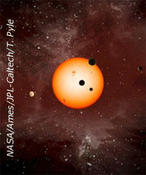
The Kepler spacecraft, launched in 2009, may have discovered as many as 1,200 new exoplanets, scientists announced today. They also shared details of a newfound planetary system with six worlds that have orbits closely packed together.

Sunday, October 24, 2010

At Last! Cometh Forth From Google: Providence Evening Tribune


Now! You, too, can play scholar becuase some of HPL's articles are now available digitally. Can't afford Hippocampus' Collected Essays of Science? Then you can read an original HPL at the link posted.

I enclose a snippet of the newspaper article to tantalize and tempt.

Honestly, I just can't read every newspaper when Lovecraft was alive, but you can read some, and others can read some, and see what was going on when he was alive. Note the 1907 Scarlet Fever pandemic, and elsewhere how overcrowded the high schools were near 1908. So much more !

Start here:

http://news.google.com/newspapers?nid=vf0YIhSwahgC&dat=19070401&printsec=frontpage

or here

http://news.google.com/newspapers?nid=vf0YIhSwahgC&dat=19070401&b_mode=2

Friday, October 08, 2010

Tracking the Elusive Lovecraft: 3 June 1909

We have a note, courtesy of David Keller and Mr. Joshi from Lovecraft's astronomical notebook. We have contemporary confirmations, as well. Lovecraft was moon-gazing.

June 3 - 1909. Moon's Eclipse. Clouds interfered but several glimpses were obtained. Total 7.58. {apparently 7.58 means that the total eclipse was to occur at 7: 58 PM - see Greeley et. al. below} Notebook of HPL.

(Click on images below to expand to larger size)


The Recent Lunar Eclipse, June 3.— Owing to the persistent clouds, the total eclipse of the moon which took place on June 3-4 was unobservable in London, but that it was well observed in other localities is shown by the reports now published.

MM. Borrelly and Coggia made observations at Marseilles, the results of which are published in No. 23 (June 7) of the Comptes rendus.

The former noted the exceptional intensity of the penumbra at the beginning of the eclipse, and a seamy appearance of the umbra which gave the front line of the shadow a sinuous appearance. In the telescope the eclipsed moon appeared rose-coloured, but to the naked eye it was red; many of the lunar circles were visible despite the shadow.

M. Coggia observed that on the approach of the shadow's edge, at 12h. 45m. (Marseilles M.T.), Plato took on a red tint, which became redder until, at 12h. 50m., it appeared like glowing charcoal.

Mr. J. H. Elgie writes that, according to his observations, at Leeds, the eclipse was a " light " one; although at its first encroachment the shadow was dead black, when the disc was fully eclipsed many features could be perceived by the naked eye. The shadow was first seen, without a telescope, at about 11.45 PM. Mr. Elgie also directs attention to a curious glow in the northern heavens throughout the night, almost suggestive of an auroral display.

From:
Nature, 24 June 1909, Vol. 80, No. 2069, pp. 502-503


World Almanac 1909


Tribune Almanac, Horace Greeley, et. al, 1909

Thursday, June 10, 2010

Lovecraft in the Scientific American (16 July 1906)


Ivan has been so kind (and patient) as I was able to get this posted.

The text from the auction:

SCIENTIFIC AMERICAN
August 25, 1906
Featuring
H.P. Lovecraft's
First Published Letter!

Hello! Up for auction is a copy of the August 25th, 1906 issue of Scientific American, featuring the FIRST PUBLISHED LETTER by the one and only H.P. Lovecraft!

In the letter, a young Lovecraft describes a way in which astronomers might discover planets outside the known solar system -- which, at the time, ended with Neptune. Interestingly, the methods described by the author would be used two years later to discover Pluto. And that same year, Pluto would play an important role in Lovecraft's great short story "A Whisperer in the Darkness."

Lovecraft famously said that the greatest fear is the fear of the unknown. But what I find particularly interesting about this letter is that it shatters the idea that Lovecraft governed his life by this credo. Indeed, a narrator in one of his stories might use the methods described in the letter and then run screaming from his telescope when the search uncovered some nameless horror lurking just behind Neptune. But Lovecraft himself embraced the search for knowledge and welcomed opportunities to expand human understanding of the cosmos. This letter demonstrates that there was more to the man than merely his popular reputation.

As such, this 100-year-old piece of Lovecraftiana is a must-have for serious collectors, and is sure to be a jewel in anyone's collection.

This copy of Scientific American is in excellent condition. The pages are still supple, shiny and bright, with very little discoloration. There are no tears or missing pages. The spine has some wear, as illustrated in the photos. Some of the string originally used to hold together the binding is exposed, but the glue edge -- which provided the binding's real strength -- is uncompromised and maintains its structural integrity. In all, this is one of the nicest copies I've seen in a long time. Remember, it's over 100 years old! It's amazing it survived at all... But to be in this condition, one can only imagine that care taken by the previous owner.

Thursday, April 22, 2010

Good Ol' Sol

This is another alien blast to the mind. NASA strung together some images and video taken in multiple spectrums. It's kind of long, but it has some Fantasia moments. After 3 minutes into it there are some scenes that trigger matrixing* that give you a feeling of Cthulhuesque images forming.

It's our sun, but we've never seen it this way before.

*(Matrixing is the mind creating personified images out of random visual elements.)

Sunday, April 18, 2010

Lovecraft's First Comet

"The first comet I ever observed was Borelli's — in Aug. 1903."

Indeed this must have been exciting for young Lovecraft. It first was visible as early as 24 July, and at least as late as the end of the month as noted in articles below. Of course his 13th birthday was 20 August 1903. Larger observatories had it tracked for much longer periods.

For young Howard, he probably tracked it from a week or so before his birthday through about a week after his birthday depending on the weather (cloudiness) at the time.

Recall that Howard had ended Grammar school in June 1903, so was very free in his activities these several weeks later. It is as yet unknown (to Chrispy) if Chester and Harold Munroe had astronomical interests at this time, but it's highly probable he spoke much about it to them.

It's also pretty likely that by now Lovecraft was rushing to the library each month to readt Popular Astronomy that carried articles constantly by Pickering and Lowell - though Bornelli's comet was most likely announced in the newspaper after 22nd or 23rd July 1903. The August-September Popular Science had a major spread on the comet - much after the fact.

_____
The most complex data are from the Lick Observatory (Bulletin No. 47, listed as "Borelly") and can be found by clicking the link attached to the blog title.
_____

Here are other independent and contemporaneous notes.

Known also as the Borelly comet: "Still another comet was discovered on June 21 by M Borelly at Marseilles. It became conspicuous early in August, but later on in the month it approached too near the sun to be seen."

_____

"The Friend", August 1, 1903, Vol. LXXVII, No.3, p.27,


Text:Borelli's comet now visible in this latitude is the brightest seen for about twelve years At present it is as bright as the pole star It is said to be traveling at about twenty five miles a second and is something like 26,000,000 of miles from the earth It can be seen best about nine o clock in the evening when it is plainly visible to the naked eye in the northeastern sky On Eighth Month 27th the astronomers have calculated that the comet will be 31,000,000 miles from the sun when it will begin to recede.
_____
Popular science monthly, Volume 64, p. 88.
The comet was noted by Alexander Graham Bell in reference to the Aurora Borealis:


____
PATTERN MAKERS JOURNAL, p. 19 (August 1903)
A comedic note:


_____
"The Summary, August 8, 1903, "News of the Week" segment.

Text: A third tail to the Borelli comet has been discovered by the astronomers at the Yale Observatory Photographs were taken on July 24 and 27 and these snow a third tail but it is also to be seen from these negatives that all the tails are broken.

_____
The Railway conductor, Volume 21‎, Page 231, 1904


And this was picked up in a number of the small press as evidenced here... "The Anamosa Prison Press", Vol. 6, No. 36, p.7 dated Saturday April 16, 1904.

Thursday, February 25, 2010

Monday, February 08, 2010

1910 Amateur Astronomy Book

http://www.archive.org/stream/amateurastronome00riegrich#page/312/mode/2up

It's a little later than HPL's active pursuit of a career, but it's also a little dated as it mentions some late 1890's issues, so it was probably drafted contemporaneous with Lovecraft's 1903-1907 headlong run at being an astronomer.

It's completely young-Howard geek-speak.

"Da Google" is continuing to make available old texts of HPL's era. Chrispy is deep into unraveling - as best I can - Lovecraft's youthful endeavors and placing them in context (sitz im leben). This weekend I began to lay out chronolgically every precisely dated instance of young Howard's 1903-1908 period, and I was stunned to see how very few precise dates there are.

Chrispy has a college ruled notebook with each month and year at the top, and a day on each line. There are massive numbers of blank pages.

All we seem to have are a few decades old remembrances from childhood acquaintances, and his own recollections many years after the fact. In most cases he's spot on, and in a few cases either fibs (graduating from high school, for instance) or spins the memory.

However, I'm not daunted. I believe if Biblical scholars can uncover fist century Christianity, and Greek scholars can uncover Homeric Greece, we can take 70,000 pages of Lovecraft letters, his dozens of stories, and reproduce 1903-1908 much more accurately than has yet been done.

All we need is 3,000 Lovecraft scholars and a quantum-computer and we're home free. Heh!

Well, we might not live that long, but the day will come if we can keep from blowing ourselves up. Still, we should give it a try. Or at least Chrispy is. :)

Tuesday, January 19, 2010

Yuggothian Unknowns: Revealed?

Here is a run down of planet science - we are not alone, it appears.
_____


The planet, called GJ 1214b, is the second super-Earth — a planet with a mass roughly between five and 10 times Earth’s — detected as it crossed in front of its star and the first that is close enough for astronomers to study its atmosphere. It is 6.5 times more massive than Earth and 2.7 times wider. GJ 1214b orbits its star, a red dwarf 40 light years from Earth, once every 38 hours at a distance of 1.3 million miles — about one-fortieth the distance between Mercury and the sun. Despite its close orbit, the planet reaches temperatures of only about 280º Celsius because its star is relatively cool.

_____

The original Yuggoth, Pluto, has clouds and the atmosphere may be composed of tiny frozen spherules of nitrogen or carbon monoxide. Evidence for life? Stay tuned.

_____

These next from Discovery Magazine top 100 science stories of 2009:

# 8, Planets are being found everywhere we look.
# 16, The Moon does have water. It seems to have an atmosphere.
# 21, water confirmed on Mars (and maybe liquid).
# 56, Saturn's moon, Titan, has stroms and weather - clouds of methane which probablt rains.
# 73, Early Venus looked somewhat like Earth.

And about ancient Earth?

#91, Earth prior to 2.4 billion years ago was thick with nickel which bred methanogen bacteria. The cooling brought in an era of cyanogen bacteria which soared the oxygen levels.

# 12, meshlike patterns distinct to spnges were found in rocks 850 million years ago. This is pretty rapid complex life formation on a planet that only had bacteria a geologic moment ago.

And finally, how quick can life form?

# 98, Chemist Reza Ghadri created a thioester peptide acid (tPNA) that is a simple, stripped down RNA/DNA. It has properties:

tPNA in solution dances about and stabilizes quickly
tPNA in a soup of DNA bits reshuffles them matching up bases
tPNA in connection with RNA conformed rapidly to the RNA alignment

_____

In essence, it does appear that life starts quickly deep under the surface of many, many planets (and moons) and if the atmosphere and temperatures are within a narrow range complex forms of life rapidly appear at the surface.

We are not alone.

Sunday, October 11, 2009

Arkham ... uh, Brown University Research

What is Lovecraft's old, almost, alma mater up to today? Maybe his essence is still attending lectures with the ghost of Professor Upton?


Link:
http://particleastro.brown.edu/darkmatter.html

Science began as the human quest for knowledge and understanding. On a short-term scale, scientific research tells us what, when, where, and how. But as part of the big picture, the purpose of scientific inquiry is and always has been to answer the biggest question of all: why? ... more ...

Monday, August 17, 2009

Twin Homunculus Clouds of Eta Carinae


Chrispy can't help but think that the man who incorporated Einstein, Hubble, and fledgling quantum physics, would not today incorporate the new theories of 'branes, big bang, and black hole theories into his weird fiction.

HPL's not with us today, so we have to speculate.

If the Eldritch Gods behaved sentient enough to have motives, emotions, and desires then I still advocate that these beings were created as universes banged into existence, and then faded with the death of entropic wheezing. In between those several billions of years they had but one desire - to live forever. Why? To master space-time. For even a dark energy creature, this is probably an impossibility, thus madness framed their existence. An unattainable goal constantly being attempted to attain.

What would a mad creature do to obtain this knowledge? No stone, no planet, no mathematical equation would be unturned to attept to achieve. A universe dies? No problem, they simply slide into a new 'brane and start over in another universe until it, too, died.

Yet, as the universes came and went, and vigntillions of years ticked like drops of water in the eternal ocean of timelessness, competitors arose. hey had to be eliminated - or dodged - or eluded - or avoided - just as long as one player attained the goal - of immortality and total power.

The ultimate game.

The ultimate madness.

In any event, this real life science event brings home what an Eldritch God might do to a star of a planet that was a bother or a problem.
Remember, to a dark energy being we are but star-ash.

_____

A massive star that exploded when the universe was just 3 billion years old has been found. It is classified as a type IIn supernova, which is caused by a star that belches out large quantities of gas before its final explosion. The fitful Milky Way star Eta Carinae (above) jettisoned the twin Homunculus clouds in 1843 and is expected to meet its end as a type IIn supernova (Image: Jon Morse/University of Colorado/NASA)
_____

Astronomers have turned up the oldest and most distant supernova ever found: the star that created it detonated just 3 billion years after the big bang. // This supernova is classified as a 'type IIn' supernova, which is caused by a star that belches out large quantities of gas before its final explosion. Its fiery death heats up that gas, causing it to glow long after light from the blast itself has faded. Indeed, the light from type IIn supernovae lasts for years, while ordinary supernovae may be visible for just a few weeks. // ..the explosions would shed light on how the universe became seeded with heavier elements. Only a few lightweight elements – hydrogen, helium, and lithium – are thought to have been created in the big bang; all others were forged over time in the nuclear furnaces of stars and in supernovae.

_____

Woodstock (Cosby, Stills, Nash)
(Excerpted, and conflated)

And I feel like I'm a cog in something turning.
And I don't know who I am but life is for learning.
We are stardust, we are golden, we are billion year old carbon,
We are stardust, we are golden, we caught in the devil’s bargain,
and we got to get ourselves back to the garden.

Monday, August 10, 2009

The Eldritch Gods Strike Again: 3 Planets So Far


Can you see the signs?

...When the stars were right, They could plunge from world to world through the sky ... [The Call of Cthulhu, HP Lovecraft]

_____

First Jupiter gets a black eye, then Venus flares white, and now Saturn's rings are whacked. Coming to a planet near you?

_____

An unknown object appears to have punched through one of Saturn's rings and left a calling card in the form of trailing debris. NASA's Cassini spacecraft snapped the image on June 11, 2009 during its ongoing tour of Saturn and its moons.

Phil Plait of Discover's Bad Astronomy likens the event to the "fist of an angry god" messing up Saturn's F ring. He also raises the question of whether mystery object X has a truly bizarre orbit around the planet which takes it up and down through the rings, or whether it's a wayward wanderer that was pulled in on collision course due to one of Saturn's moons.

Link

Sunday, July 26, 2009

Jupiter's Scar: The Old Ones Warning Us?

{Well, maybe not. Lovecraft, always fascinated by astronomomy, would have been excited for a day such as today. He might have incorporated something like this as a warning of how infinitesimal we are as a species, and how the Greater Beings could easily annihilate us. Or change us. Or drive us into madness.}


This Hubble picture, taken on July 23, by the new Wide Field Camera 3, is the sharpest visible-light picture taken of the atmospheric debris from a comet or asteroid that collided with Jupiter on July 19. This is Hubble's first science observation following its repair and upgrade in May. The size of the impactor is estimated to be as large as several football fields.


Link

Thursday, July 23, 2009

"They" are watching?

It was only in Lovecraft's lifetime that scientists realized there were galaxies. look how far we've come.


July 23, 2009

PASADENA, Calif. -- NASA's Spitzer Space Telescope has imaged a wild creature of the dark -- a coiled galaxy with an eye-like object at its center.

The galaxy, called NGC 1097, is located 50 million light-years away. It is spiral-shaped like our Milky Way, with long, spindly arms of stars. The "eye" at the center of the galaxy is actually a monstrous black hole surrounded by a ring of stars. In this color-coded infrared view from Spitzer, the area around the invisible black hole is blue and the ring of stars, white.

The black hole is huge, about 100 million times the mass of our sun, and is feeding off gas and dust along with the occasional unlucky star. Our Milky Way's central black hole is tame by comparison, with a mass of a few million suns.

"The fate of this black hole and others like it is an active area of research," said George Helou, deputy director of NASA's Spitzer Science Center at the California Institute of Technology in Pasadena. "Some theories hold that the black hole might quiet down and eventually enter a more dormant state like our Milky Way black hole."

Wednesday, July 22, 2009

The Solar Eclipse: 21 July 2009

I think Lovecraft would first be thrilled at our ability to see astronomical events, appalled that superstition still reigns, and would find some way to admix these two world views into a weird story of some sort. He often did. One can here him "tsk" at the "grandmothers" and their "superstitions".


TAREGNA, India – The longest solar eclipse of the 21st century created near darkness soon after dawn in a swath of India stretching from the west coast to the northern plains where millions gathered in the open to watch.

But millions more shuttered themselves in, gripped by fearful myths in a country that abounds in Hindu mythology-based superstitions and fables, one of which says an eclipse is caused when a dragon-demon swallows the sun.

At its peak, the eclipse lasted 6 minutes and 39 seconds in other parts of Asia.

It is the longest such eclipse since July 11, 1991, when a total eclipse lasting 6 minutes, 53 seconds was visible from Hawaii to South America. There will not be a longer eclipse than Wednesday's until 2132.

But millions across India were shunning the sight and planned to stay indoors.

Even in regions where the eclipse was not visible, pregnant women were advised to stay indoors in curtained rooms over a belief that the sun's invisible rays would harm the fetus and the baby would be born with disfigurations, birthmarks or a congenital defect.

Krati Jain, a software professional in New Delhi, said she planned to take a day off from work Wednesday to avoid what she called "any ill effects of the eclipse on my baby."

"My mother and aunts have called and told me stay in a darkened room with the curtains closed, lie in bed and chant prayers," said Jain, 24, who is expecting her first child.

In the northern Indian state of Punjab, authorities ordered schools to begin an hour late to prevent children from venturing out and gazing at the sun.

Tuesday, July 21, 2009

Eldritch Magic on Jupiter?

What would Lovecraft think? Would this have wnet in one of his stories as an eldritch machination of the Old Ones?


July 20, 2009

Scientists have found evidence that another object has bombarded Jupiter, exactly 15 years after the first impacts by the comet Shoemaker-Levy 9.

Following up on a tip by an amateur astronomer, Anthony Wesley of Australia, that a new dark "scar" had suddenly appeared on Jupiter, this morning between 3 and 9 a.m. PDT (6 a.m. and noon EDT) scientists at NASA's Jet Propulsion Laboratory in Pasadena, Calif., using NASA's Infrared Telescope Facility at the summit of Mauna Kea, Hawaii, gathered evidence indicating an impact.

New infrared images show the likely impact point was near the south polar region, with a visibly dark "scar" and bright upwelling particles in the upper atmosphere detected in near-infrared wavelengths, and a warming of the upper troposphere with possible extra emission from ammonia gas detected at mid-infrared wavelengths.

"We were extremely lucky to be seeing Jupiter at exactly the right time, the right hour, the right side of Jupiter to witness the event. We couldn't have planned it better," said Glenn Orton, a scientist at JPL.

Orton and his team of astronomers kicked into gear early in the morning and haven't stopped tracking the planet. They are downloading data now and are working to get additional observing time on this and other telescopes.

This image was taken at 1.65 microns, a wavelength sensitive to sunlight reflected from high in Jupiter's atmosphere, and it shows both the bright center of the scar (bottom left) and the debris to its northwest (upper left).

"It could be the impact of a comet, but we don't know for sure yet," said Orton. "It's been a whirlwind of a day, and this on the anniversary of the Shoemaker-Levy 9 and Apollo anniversaries is amazing."

Shoemaker-Levy 9 was a comet that had been seen to break into many pieces before the pieces hit Jupiter in 1994.

Leigh Fletcher, a NASA postdoctoral fellow at JPL who worked with Orton during these latest observations said, "Given the rarity of these events, it's extremely exciting to be involved in these observations. These are the most exciting observations I've seen in my five years of observing the outer planets!"

The observations were made possible in large measure by the extraordinary efforts of the Infrared Telescope Facility staff, including telescope operator William Golisch, who adroitly moved three instruments in and out of the field during the short time the scar was visible on the planet, providing the wide wavelength coverage.


Link

Tuesday, June 16, 2009

Betelgeuse & Lovecraft (Real Life Lovecraftian Science)


(Above) Constellation containing Betegeuse.
_____

(Above) Image of the Red Star
______
“Good luck with Hastur—but don’t use any word sounding like ‘Betelgeuse’ to represent a primal name of that distant sun (or to represent the name used by the denizens of any of its hypothetical planets) since this name is an Arabic product of the Middle Ages, and signifies ‘the armpit (or shoulder) of the giant (or central one)’—Ibn at Jauzah—Orion having been known as Al Jauzah to the astronomers of the Saracenic Caliphate—who did so much to advance the science.” (to August Derleth, 30 January 1933)
______

Chrispy does not typically follow the intricacies of the modern Mythos games, but in this case it's notable to know that: The ancient battleground in which the Elder Gods and the Great Old Ones fought their apocalyptic and unfathomable war, the system of Betelgeuse – rendered “Glyu-Uho” in Naacal – contains innumerable worlds pocked with the scabrous remnants of ancient and often non-Euclidean cities scarred with the uncanny wounds of primordial conflict. The principle inhabited world of the Betelgeuse System is Yarnak, a shattered world rebuilt by initially optimistic if perhaps foolhardy settlers. /// August Derleth and Mark Schorer’s “The Lair of the Star-Spawn” (published in the February 1932 issue of Weird Tales) mentions the “Great Old Ones” - but as the beings from Betelgeuse and Rigel who imprisoned Cthulhu and his kindred!

______

11 June 2009

Bye-bye, Betelgeuse?

The nearby, well-known and very bright star may soon explode in a supernova, according to data released by U.C. Berkeley researchers Tuesday.

The red giant Betelgeuse, once so large it would reach out to Jupiter's orbit if placed in our own solar system, has shrunk by 15 percent over the past decade in a half, although it's just as bright as it's ever been.

"To see this change is very striking," said retired Berkeley physics professor Charles Townes, who won the 1964 Nobel Prize for inventing the laser. "We will be watching it carefully over the next few years to see if it will keep contracting or will go back up in size."

Betelgeuse, whose name derives from Arabic, is easily visible in the constellation Orion. It gave Michael Keaton's character his name in the movie "Beetlejuice" and was the home system of Galactic President Zaphod Beeblebrox in "The Hitchhiker's Guide to the Galaxy."

Saturday, May 30, 2009

Edwin Hubble and Lovecraft


_____
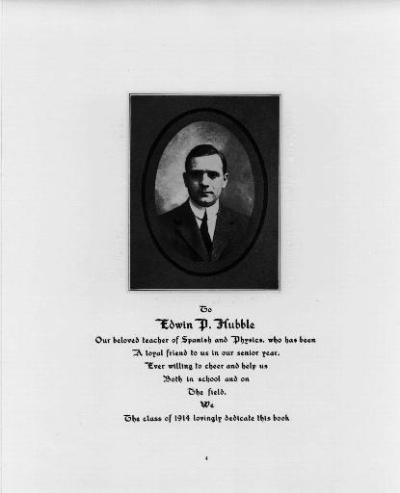
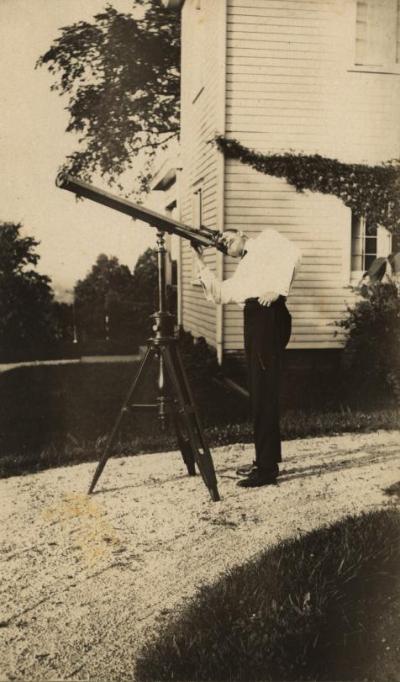
Above, Hubble the dedicatory of the New Albany High School yearbook, with his basketball stars, the first know picture of him with a telescope, and spelunking in Wyandotte Cave.
_____


In 1923, Hubble made a profound discovery: He showed that the "spiral nebulae" that were previously presumed to be within our galaxy, the Milky Way, were actually other galaxies that lay far beyond our own. The following year, he showed that the Milky Way was just one of many galaxies in the universe.

Lovecraft, always keen to read about astronomical phenomenon would not have missed this news alert. In October 1923, part of the New York Times headline read: "Finds spiral nebulae are stellar systems. Doctor Hubbel [sic] confirms view that they are 'island universes' similar to our own."

Lovecraft had already forumlated key nihilist aspects of his weird tales, and after 1923 he progressed to write more intense examples of man's inconsequential existence in the vastness of the universe.

As Lovecraft was proud of his Providence, Chrispy is equally proud that Louisville has played some prominence in history. For a portion of his life, Hubble was a member of the Kentuckiana region. Click Here to see of those times: His family lived there between 1909 - 1916. A 1914 yearbook from his high school teaching assignment showed that the girls were "ga ga over him as they indicated in a dedicating the New Albany High School yearbook to him. He placed, as coach, third place in the state basketball tournament that year.

If Lovecraft had etter tutorng in mathematics, his grandfather had not died so soon, this could have been Lovecraft's life, too. From college, to high school teacher, and perhaps astronomical greatness. Instead, he switched to poetry, and then to weird tales.

{I've not had time to research if Lovecraft actually quoted Hubble in any letters.}

Followers

Blog Archive

Facebook:

Google Analytics