
I found this little - ugh - gem on Sunday afternoon on the 23 November 2010 but could not bring myself to post it before Thanksgiving.
Imagine you are Howard Lovecraft. You are sensitive to all kinds of strong smells. In fact they make you ill. Especially anything that reaks of fishiness - a type of degenerative amine smell.
Now, do you have that firmly in your mind, Horror Lover?
Now, imagine you are attending Hope Street High School, a community school with all sorts of boys, from all sorts of backgrounds. And read this complaint by the Principal of Hope Street in 1912. While it is from several years after HPL attended, the conditions were explicit, and the conditions had lingered from the earliest days of the school.
Read on ...
As principal of the Hope Street High School I beg leave to present the following report for the year ending June, 1912:
...I wish to call attention to the condition of the boys' toilet room. At the time that the school was built the style of urinals installed was antiquated. At the Classical High School, which was erected a year before the Hope Street School, the urinal system is modern and hygienic. Even in the English High School, which was built many decades ago, the system is at least sanitary. At the Hope Street School the urinals are offensive, both in odor and appearance, and a positive menace to health. The toilet room is situated opposite the lunch room, and the caterer has spoken frequently of the noisome odors that permeate the basement. Teachers notice the odors as they pass the staircase on the floor above. Even pupils complain. The principal has done his best for several years to get these conditions abated. The means he has employed have been those of applying to all committees with any kind of jurisdiction over the high schools, including the Committee on Hygiene and the City Property Committee of the City Council. I make one more plea to have these offensive conditions removed at once and a modern and sanitary system installed, preferably one with standing slate and constant flow.
Respectfully,
Charles E. Dennis, Jr.,
Principal.
Welcome to the underside of Young Howard's world.
I can only envision that the urinal was of a trough method that gravity drained to a central area, and that there was no stain-resistant or non-porous barrier. Therefore, probably only highly permeable wood and mortar formed the back-splash? Otherwise, the conditions must have been intense.
Again, imagine you are Howard Lovecraft in that environment.
Showing posts with label Hope Street High School. Show all posts
Showing posts with label Hope Street High School. Show all posts
Wednesday, December 01, 2010


Sunday, November 28, 2010
Lovecraft and High School
As loyal readers of the HPLblog know, Chrispy does research without a net. Sometimes errors are made as theses are created, but so much more the excitement.
A long running thesis is that Lovecraft was so sickly he could not attend school. Chrispy, for right or wrong, has denied this. Yes, young Howard got sick, sometimes very sick, but in the fin de siecle days and those years before antibiotics this happened in all families.
One persevered.
Another long standing theory is that Susan coddled HPL. Maybe shed did a little, as he was "spoiled", but for every indulgence she gave, grandfather was there to temper it. WVP had been orphaned at 14, and built and lost fortunes. His eye was on a grandson who would most likely inherit his mantle (certainly not Edwin).
Lovecraft attended school precisely twice (before late 1904). It is not a coincidence that these were precisely the years Lovecraft needed to "graduate" from both primary and grammar school.
Previously it was discussed that the Providence school system went from a 1A/B 5 yr old to 9A/B 13 yr old system, to a 1A/B 6 yr old to 8A/B 13 yr old system in 1902, whereby preparing continuity from grammar school to High School. This essentially created a "graded school" all the way from 1 to 12, a very familar system today.
The Providence school system was the premier and model system for virtually all other Eastern and many Midwestern systems. The educators went on the road giving seminars, and New York and Boston ofen followed the lead of Providence. The system believed strongly in co-educational environments and in social ethnic integration (but not necessarily black students, just sometimes).
The system was not at all lenient with truancy, and battled manufacturers who wanted children to work instead of going to school, and bristled when said that they did not educate to train for industry. If Lovecraft was simply dodging school, or Susan fearful of him mingling, then the school system would have went after them. There are many reports of this very issue in the historical record.
There was one major exception. Elites.
While the school system wished all students to associate for th e greater good of society and America, they understood that a classroom education for brilliant and elite pupils was lackluster, and gave great leeway for private education.
Thus enters Whipple - and perhaps for a time, Lillian. Whipple was not only a powerful man in Providence business society, with long established (at least back to the late 1850's) roots in Providence, but also was a recognized and established educator in his own right. His name appears on several state school documents from the 1870's. He was close friends with masons, bankers (brother-in-law Raymond G Place, for instance), Brown professors, legislators, aldermen, and the Foster mafia ran strong in Rhode Island politics - all the way to his best freind, Clarke Johnson being supreme court justice one day.
When Lovecraft said he was the grandson of Whipple Phillips, people raised an eyebrow and understood.
My thesis continues to be that the Providence school system compromised. That Howard Lovcraft could be educated at home as long as he "graduated" from primary and grammar school. Coincidently, the 4 room primary Slater Elementary school expanded to be a grammar school in 1902. This is why its senior administrator (Principal) "Abbie" Hathaway knew HPL so well.
Now, what about High School?
Lovecraft graduated late June 1903 from grammar school and should have immediately attended a high school the second Monday of Septmeber 1903. He was 13 after all. He would have clearly been eligible to be a Freshman.
He didn't.
Why? Too sickly? Me thinks not.
Whipple continued his private education. WVP brought in at least one tutor by the name of A. P. May for Fall 1903. He was a Brown University student studying for the ministry (if memory serves), and Lovecraft immediately recoiled and by January 1904 HPL was probably at war, openly mocking him - or at least he does in his science newsletter circulated to family members.
So what happened?
Sadly, on Monday, 28 March 1904, WVP passed on.
The Lovecrafts moved in June 1904 to 598 Angell Street next door to the Metcalf family (long residents at 600 Angell), and Susan entered Howard into Hope Street High School on the 2nd Monday of September.
There is debate about whether HPL accumulated enough credits for Brown University to accept him. No real way to answer this precisely after all these years, except that had HPL taken the entrance exams and passed algebra, I think he could easily have entered in 1909.
He didn't pass.
The other courses might have caused him to take some remedial work, but the senior staff at Hope Street High School knew him and probably backed him. Lovecraft says "they understood" him. They may have given his a few passes due to his several maladies. There is no hint otherwise.
Winslow Upton was still quite influential at Brown (once senior Dean), and while we can debate whether he backed Howard, we know from all accounts he was a kind and sympathetic man who loved his students, and his students adored him. It's hard to say that Upton groomed Lovecraft, for if he did, he would have been more insistent that he concentrate on math, but there is no doubt he knew Lovecraft - as did the entire staff at Ladd Observatory. I believe him when he says he had the keys.
I certainly believe that HPL got a personal introduction to Percival Lowell on January 1907. Many in Providence read HPL's astronomy newspaper features - a competition not so much with Upton's Providence Journal series, but with other sysndicated astonomy features of the time.
Howard had inherited some of Whipple's charisma, and people seemed to automatically believe "the Little Professor" was inevitable to be an astronomer or meteorologist.
If HPL had taken the August college exams and passed, he would have gotten into Brown, I believe.
He didn't.
He was in shock.
He had no immediate fall back plan, and must have been beyond devastated.
He had worked eevry day from late 1902 to become an astonomer, and at that point no one could help him further.
Monday, September 06, 2010
Florence H Slack (Hope Street High School)
In Lovecraft's boyhood, Providence schols tended to start the second week of September. So, welcome back to school!
_____
This item I purchased for a mere $0.99 plus freight in June 2010. It haunted me, not just because of the Philbrick and Hope Street High School connection, but because this vibrant teacher was being sold for a paltry 99 cents. It seemed unfair, and so after two rounds of not being sold, I purchased it in honor of her memory.
One form of immortality is to be remembered. As a Baptist, I believe in an afterlife, but I also feel strongly that individuals should be honored and respected here and now – even after their death; especially after their death. More so one of noble and giving character.
To my recollection, Lovecraft never mentioned this teacher. It's impossible for hiom not to have seen her or known of her. There is a principal taht states: Just becuase something is not memntioned does not preclude it from happening. In science, one deals in probability. So, also, does one deal in historical probabilities. It's clear that Philbrick knew Slack, and so while we have no evidence that Lovecraft was close to Slack, he had to know of her, and perhaps crossed her path several times in his roughly four years at Hope Street High School.
_____


Below, I trace out a few items in Florence H.Slack's career. It is cursory, but will give you a feel for her activities and vibrance. I suspect that she taught debate and drama as well as English. In 1905, for instance, the debate team won several times (in the 1905 Providence Hope Street High School Year Book), even though she is not specifically mentioned.
_____
Florence H Slack
b. 1876 – d. 1956)
Interred at North Burial Ground of Providence
Report of School Committee of 1899-1900 reports, " In June of 1897 Miss Flora A Fraser of the Sargent School of Physical Training was elected to the position During the same time the work for boys in the English High School was under the care of Mr John Howland for girls directed by Miss Sybil Avery In the Classical High School Miss Charlotte Morrill had charge and in the East Side High School Miss Florence H Slack".
The 1903 Butler Hospital Report has this paragraph, " We are indebted for entertainments to … {others and} … Miss Florence H Slack and pupils and alumni of Hope Street High School"
1904 she is listed )City Directory) as Fourth Assistant at Hope Street High School. That same year in "American Physical Education Review" she is listed at 1240 Westminster St., Providence, but for non-payment of dues, and thus dropped from membership. Located in Room 2R (which seems to be her constant room through her career).
In 1907 she is still listed (City Directory) as Fourth Assistant at Hope Street High School.
1917-1918 school year at Hope Street High School as Third Assistant. (Providence City Manual 1917-1918)
The 1929-1940 Brown University Report lists her at Hope Street High School under "Public Speaking" as her specialty.
Her retirement occurred with much fanfare in 1946 (Perridas has the small program) with attendance and speeches by the Superintendent of Schools, Prinicipal Wood of Hope Street High Schol, and of Lovecraft significance, Clarence H. Philbrick, graduate 1909.
_____
b. 1876 – d. 1956)
Interred at North Burial Ground of Providence
_____
And this interesting article from 1921:
The Drama, Volume 11, October, 1920-September, 1921
_____
The Providence Players and Other New England Activities
..'THERE are on the average three or four amateur dramatic performances given in different parts of greater Providence every night. About every new church or parish house building has some sort of'stage nowadays. Many schools are adding to their equipment in spite of obnoxious and unnecessary build* ing instructions, and clubs of all sorts are developing interest in dramatic directions.
At Pembroke, the women's college in Brown University, a number of admirable performances have been given. Among them was The Amazons, presented by the Senior Class, directed by Sarah Minchin-Barker and staged by Marshall Sheldon, and Quality Street under the same direction and played by the Alumnae Association. Several out-of-door pageants have been given, and a recent program of four original plays presented by the four classes of the college, and dealing with college affairs, afforded stimulus to youthful playwrights.
..Among the public school hall performances the presentation of three one-act plays by members of The Players at the John Howland Grammar School under the auspices of the Parent Teachers Association was one of the most notable. School hall performances, in which pupils are the participants, are ambitiously given under the direction of Miss Florence Slack and Mrs. Hesse who are the dramatic directors for the city high schools, and Miss Adelaide Patterson, at the Rhode Island State Normal School. Miss Patterson, who has acted many parts with The Players, has written several short plays, and pageants, which have been favorably received.
..Dramatic productions at the Lincoln School (a large private institution with grounds adjoining Blackstone Park) are under the direction of Miss Marion Cole, also a member of the Players. At least one Shakespearean play is annually presented, besides the pageants given in the park. As You Like It was the offering in April of this year and was especially meritorious.
..Under Miss Slack's direction the Technical High School alumni performed Eliza Comes to Stay, with Herbert Butterfield, a Players' member and assistant to Mr. Crosby at Brown, in the leading part.The play selected for the spring production of the Sock and Buskin Society of Brown this year, Nothing but the Truth, received its initial production at the Mayflower Theatre.
..The Providence Art Club for several years past has manifested an interest in things dramatic. The annual Christmas carnival under the charge of Marshall* B. Martin has taken on the form of a burlesque show with wonderful scenic surprises taxing the ingenuity and skill of many of the professional artist members of that popular club to devise. This is generally performed for the masculine contingent or "Friday Knights" the Friday night preceding Christmas, and repeated on a ladies' night immediately afterwards. Some of the unwritten parts of the dialogue are intentionally delivered impromptu and usually some of the written portions unintentionally so. Later in the season performance? in more finished dramatic style and serious purpose are presented, and all of the productions are naturally mounted with great decorative and scenic skill volunteered by the ablest artists in Providence. The varied programs include experiments representative of all the new schools there are. The collection of one-act plays presented by Mr. Crosby included Where but in America, A Constant Lover, by St. John Hankife, and The Marriage will not Take Place, by Sutro.
..The stage settings, by Percy Albee, cleverly satirized some phases of the so-called new and decorative school, the embellishment for the Constant Lover including various nimble fauns in a purple wood, supposedly typifying the inconstancy of the youth who is constantly in love.
..Another three-play program, recently given with success' was presented by some of The Players under the auspices of the new Plantations Club whose membership is composed of professional women, at the Elks' Auditorium. Average, A Constant Lover, and Food were the plays given, and as is the case with nearly all such presentations nowadays, as much care was bestowed upon the setting and lighting as upon the action.
..Other groups of three one-act plays have recently been given for the Pawtucket Women's Club and on various church vestry stages for French War Relief, and the like. The Plantations Club also stood sponsor for a propaganda play designed to give impetus to the drive for the fund for the Providence District Nurses Association. This was produced in their auditorium upon a "portmanteau" stage recently constructed by William E. Bridgham, director of design at the R. I. School of Design. The play, From Door'to Door, furnished an interesting example of the possibilities of story playing of an advanced type, as it was constructed largely in scenario form, with but a small portion of the actual dialogue written out. The rest was provided in an impromptu manner by the players who presented with full regard to dramatic characterization and with vividly convincing effect the various scenes making up the story, demonstrative of the work of the district nurses among the poor— all vivid to the audience of volunteer workers assembled to get inspiration in entertainment form, as a prelude to their work for the annual tag day work. As a result of this, the financial results were nearly twice as great as usual.
The play was conceived and arranged by Paul B. Howland of the Providence Journal dramatic staff, and an acting member of The Players.
..Performances of The Witching Hour by the Epiphany Players in the Elmwood district of Providence were of unusually creditable character for so young an organization. This club has been in existence for about two years and gives its productions in the fine parish housa hall of the Episcopal Church of the Epiphany, four of - the annual offerings being given for the benefit of various church activities and the fifth one for the club itself, for the purpose of adding to its working equipment
..For many years in Providence much dramatic activity has been manifested by various foreign language speaking groups of performers recruited from its cosmopolitan population. Among those are regular productions at the Talma Theatre in Infantry Hall by the Portuguese Young Men's Educational Association (Club de Instrucao des Fillies de Portugal), and various Armenian, Swedish and Italian clubs.]
The residential towns surrounding Boston have for many years supported flourishing amateur dramatic organizations. Among these are the Footlight Club, of the Jamaica Plain district (Boston); the Concord Dramatic Club; the Cambridge Social Dramatic Club; the Newton Players, which has a splendid private theatre; the Belmont Dramatic Club; and the Brookline Comedy Club. Several of these clubs have been in existence for over a quarter of a century and without advertising any claims to noteworthy experiments in any new art direction, have long been conducted under able and artistic leadership, and presented work of much dramatic merit.
..Many women's clubs in the smaller cities and towns are featuring the work of thoir dramatic departments and subcommittees. An example of this is the woman's club of Plymouth, Mass., which has only recently produced Green Stockings and The Fascinating Mrs. Vunderfeldt at the local theatre, and now has Pomander Walk in contemplation with the special setting built for that play by the Providence Players.—[Henry A. Barker.
_____
-Not to be confused with Mrs. Florence H. Slack, aged 72, widow of Jessie B. Slack, died at the home of her son-in-law, Harry R. Solliday, Trenton, N. J., on Friday, April 27, 1928; Bucks, Pa.
_____
This item I purchased for a mere $0.99 plus freight in June 2010. It haunted me, not just because of the Philbrick and Hope Street High School connection, but because this vibrant teacher was being sold for a paltry 99 cents. It seemed unfair, and so after two rounds of not being sold, I purchased it in honor of her memory.
One form of immortality is to be remembered. As a Baptist, I believe in an afterlife, but I also feel strongly that individuals should be honored and respected here and now – even after their death; especially after their death. More so one of noble and giving character.
To my recollection, Lovecraft never mentioned this teacher. It's impossible for hiom not to have seen her or known of her. There is a principal taht states: Just becuase something is not memntioned does not preclude it from happening. In science, one deals in probability. So, also, does one deal in historical probabilities. It's clear that Philbrick knew Slack, and so while we have no evidence that Lovecraft was close to Slack, he had to know of her, and perhaps crossed her path several times in his roughly four years at Hope Street High School.
_____


Below, I trace out a few items in Florence H.Slack's career. It is cursory, but will give you a feel for her activities and vibrance. I suspect that she taught debate and drama as well as English. In 1905, for instance, the debate team won several times (in the 1905 Providence Hope Street High School Year Book), even though she is not specifically mentioned.
_____
Florence H Slack
b. 1876 – d. 1956)
Interred at North Burial Ground of Providence
Report of School Committee of 1899-1900 reports, " In June of 1897 Miss Flora A Fraser of the Sargent School of Physical Training was elected to the position During the same time the work for boys in the English High School was under the care of Mr John Howland for girls directed by Miss Sybil Avery In the Classical High School Miss Charlotte Morrill had charge and in the East Side High School Miss Florence H Slack".
The 1903 Butler Hospital Report has this paragraph, " We are indebted for entertainments to … {others and} … Miss Florence H Slack and pupils and alumni of Hope Street High School"
1904 she is listed )City Directory) as Fourth Assistant at Hope Street High School. That same year in "American Physical Education Review" she is listed at 1240 Westminster St., Providence, but for non-payment of dues, and thus dropped from membership. Located in Room 2R (which seems to be her constant room through her career).
In 1907 she is still listed (City Directory) as Fourth Assistant at Hope Street High School.
1917-1918 school year at Hope Street High School as Third Assistant. (Providence City Manual 1917-1918)
The 1929-1940 Brown University Report lists her at Hope Street High School under "Public Speaking" as her specialty.
Her retirement occurred with much fanfare in 1946 (Perridas has the small program) with attendance and speeches by the Superintendent of Schools, Prinicipal Wood of Hope Street High Schol, and of Lovecraft significance, Clarence H. Philbrick, graduate 1909.
_____
b. 1876 – d. 1956)
Interred at North Burial Ground of Providence
_____
And this interesting article from 1921:
The Drama, Volume 11, October, 1920-September, 1921
_____
The Providence Players and Other New England Activities
..'THERE are on the average three or four amateur dramatic performances given in different parts of greater Providence every night. About every new church or parish house building has some sort of'stage nowadays. Many schools are adding to their equipment in spite of obnoxious and unnecessary build* ing instructions, and clubs of all sorts are developing interest in dramatic directions.
At Pembroke, the women's college in Brown University, a number of admirable performances have been given. Among them was The Amazons, presented by the Senior Class, directed by Sarah Minchin-Barker and staged by Marshall Sheldon, and Quality Street under the same direction and played by the Alumnae Association. Several out-of-door pageants have been given, and a recent program of four original plays presented by the four classes of the college, and dealing with college affairs, afforded stimulus to youthful playwrights.
..Among the public school hall performances the presentation of three one-act plays by members of The Players at the John Howland Grammar School under the auspices of the Parent Teachers Association was one of the most notable. School hall performances, in which pupils are the participants, are ambitiously given under the direction of Miss Florence Slack and Mrs. Hesse who are the dramatic directors for the city high schools, and Miss Adelaide Patterson, at the Rhode Island State Normal School. Miss Patterson, who has acted many parts with The Players, has written several short plays, and pageants, which have been favorably received.
..Dramatic productions at the Lincoln School (a large private institution with grounds adjoining Blackstone Park) are under the direction of Miss Marion Cole, also a member of the Players. At least one Shakespearean play is annually presented, besides the pageants given in the park. As You Like It was the offering in April of this year and was especially meritorious.
..Under Miss Slack's direction the Technical High School alumni performed Eliza Comes to Stay, with Herbert Butterfield, a Players' member and assistant to Mr. Crosby at Brown, in the leading part.The play selected for the spring production of the Sock and Buskin Society of Brown this year, Nothing but the Truth, received its initial production at the Mayflower Theatre.
..The Providence Art Club for several years past has manifested an interest in things dramatic. The annual Christmas carnival under the charge of Marshall* B. Martin has taken on the form of a burlesque show with wonderful scenic surprises taxing the ingenuity and skill of many of the professional artist members of that popular club to devise. This is generally performed for the masculine contingent or "Friday Knights" the Friday night preceding Christmas, and repeated on a ladies' night immediately afterwards. Some of the unwritten parts of the dialogue are intentionally delivered impromptu and usually some of the written portions unintentionally so. Later in the season performance? in more finished dramatic style and serious purpose are presented, and all of the productions are naturally mounted with great decorative and scenic skill volunteered by the ablest artists in Providence. The varied programs include experiments representative of all the new schools there are. The collection of one-act plays presented by Mr. Crosby included Where but in America, A Constant Lover, by St. John Hankife, and The Marriage will not Take Place, by Sutro.
..The stage settings, by Percy Albee, cleverly satirized some phases of the so-called new and decorative school, the embellishment for the Constant Lover including various nimble fauns in a purple wood, supposedly typifying the inconstancy of the youth who is constantly in love.
..Another three-play program, recently given with success' was presented by some of The Players under the auspices of the new Plantations Club whose membership is composed of professional women, at the Elks' Auditorium. Average, A Constant Lover, and Food were the plays given, and as is the case with nearly all such presentations nowadays, as much care was bestowed upon the setting and lighting as upon the action.
..Other groups of three one-act plays have recently been given for the Pawtucket Women's Club and on various church vestry stages for French War Relief, and the like. The Plantations Club also stood sponsor for a propaganda play designed to give impetus to the drive for the fund for the Providence District Nurses Association. This was produced in their auditorium upon a "portmanteau" stage recently constructed by William E. Bridgham, director of design at the R. I. School of Design. The play, From Door'to Door, furnished an interesting example of the possibilities of story playing of an advanced type, as it was constructed largely in scenario form, with but a small portion of the actual dialogue written out. The rest was provided in an impromptu manner by the players who presented with full regard to dramatic characterization and with vividly convincing effect the various scenes making up the story, demonstrative of the work of the district nurses among the poor— all vivid to the audience of volunteer workers assembled to get inspiration in entertainment form, as a prelude to their work for the annual tag day work. As a result of this, the financial results were nearly twice as great as usual.
The play was conceived and arranged by Paul B. Howland of the Providence Journal dramatic staff, and an acting member of The Players.
..Performances of The Witching Hour by the Epiphany Players in the Elmwood district of Providence were of unusually creditable character for so young an organization. This club has been in existence for about two years and gives its productions in the fine parish housa hall of the Episcopal Church of the Epiphany, four of - the annual offerings being given for the benefit of various church activities and the fifth one for the club itself, for the purpose of adding to its working equipment
..For many years in Providence much dramatic activity has been manifested by various foreign language speaking groups of performers recruited from its cosmopolitan population. Among those are regular productions at the Talma Theatre in Infantry Hall by the Portuguese Young Men's Educational Association (Club de Instrucao des Fillies de Portugal), and various Armenian, Swedish and Italian clubs.]
The residential towns surrounding Boston have for many years supported flourishing amateur dramatic organizations. Among these are the Footlight Club, of the Jamaica Plain district (Boston); the Concord Dramatic Club; the Cambridge Social Dramatic Club; the Newton Players, which has a splendid private theatre; the Belmont Dramatic Club; and the Brookline Comedy Club. Several of these clubs have been in existence for over a quarter of a century and without advertising any claims to noteworthy experiments in any new art direction, have long been conducted under able and artistic leadership, and presented work of much dramatic merit.
..Many women's clubs in the smaller cities and towns are featuring the work of thoir dramatic departments and subcommittees. An example of this is the woman's club of Plymouth, Mass., which has only recently produced Green Stockings and The Fascinating Mrs. Vunderfeldt at the local theatre, and now has Pomander Walk in contemplation with the special setting built for that play by the Providence Players.—[Henry A. Barker.
_____
-Not to be confused with Mrs. Florence H. Slack, aged 72, widow of Jessie B. Slack, died at the home of her son-in-law, Harry R. Solliday, Trenton, N. J., on Friday, April 27, 1928; Bucks, Pa.
Saturday, June 26, 2010
Hope Street High School Principal (1898-1901)
This predates Lovecraft's experience with Hope Street High School by about 4 years, but is only a "near miss" and interesting to historians and antiquarians of Proviidence.

From the seller: Walter Ballou Jacobs (1861-1932), professor of education, was born in Providence on May 5, 1861. After graduation from Brown in 1882, he studied for a year at Union Theological School. He taught in the classical department of Providence High School from 1883 to 1898, when he was made principal of the new Hope Street High School, a post he held until 1901. While he was teaching in the public schools, he was also instructor in pedagogy at Brown from 1893 to 1895 and associate professor from 1895 to 1901. As early as 1895 he introduced the idea of practice teaching for graduate students in secondary schools under actual classroom conditions. When he left the city school system, he was named professor of the theory and practice of education. He undertook the reorganization of university extension courses in 1906, and with only four courses attracted 500 registrations. He was director of university extension from 1915 until 1931, by which time the registration had climbed to 3400 persons in nearly sixty courses. Jacobs had nearly 500 in his extension course on ?Psychology for Daily Life.? He was director of the School of Education from 1923 to 1927. He was obliged to retire when he reached the age of seventy. The year before he taught a course in ?Applied Social Psychology? in Boston. He died in Plattsburgh, New York on June 23, 1932.

From the seller: Walter Ballou Jacobs (1861-1932), professor of education, was born in Providence on May 5, 1861. After graduation from Brown in 1882, he studied for a year at Union Theological School. He taught in the classical department of Providence High School from 1883 to 1898, when he was made principal of the new Hope Street High School, a post he held until 1901. While he was teaching in the public schools, he was also instructor in pedagogy at Brown from 1893 to 1895 and associate professor from 1895 to 1901. As early as 1895 he introduced the idea of practice teaching for graduate students in secondary schools under actual classroom conditions. When he left the city school system, he was named professor of the theory and practice of education. He undertook the reorganization of university extension courses in 1906, and with only four courses attracted 500 registrations. He was director of university extension from 1915 until 1931, by which time the registration had climbed to 3400 persons in nearly sixty courses. Jacobs had nearly 500 in his extension course on ?Psychology for Daily Life.? He was director of the School of Education from 1923 to 1927. He was obliged to retire when he reached the age of seventy. The year before he taught a course in ?Applied Social Psychology? in Boston. He died in Plattsburgh, New York on June 23, 1932.
Friday, June 25, 2010
Hope Street circa 1900
This is a providence view of Hope Street circa 1900. I'm afraid I can't pin down precisely what address or part of Hope Street, but the handwritten text mentions "adr. 170 Hope Street". The postmark is said to be 1907, and the card date is said to be printed about 1905.


Wednesday, June 09, 2010
Hope Street Reservoir (c.1907)

First I've seen of this. It is very near and across from Hope Street High School. I believe that Lovecraft would have seen it nearly every single day of his High School life.
Saturday, June 05, 2010
Florence Slack


FYI, Clarence Horace Philbrick was a classmate of Lovecraft's.
Clarence H. PHILBRICK was born on 11 May 1891 in Providence and probably this blurb I found:
"Clarence H. Philbrick and Ellis L. Yatman '11 were among those re-elected in
November to the Board of the Home for Aged Men and -Aged Couples in Providence."
Monday, May 31, 2010
Hope Street High School (c. 1902) Part 2
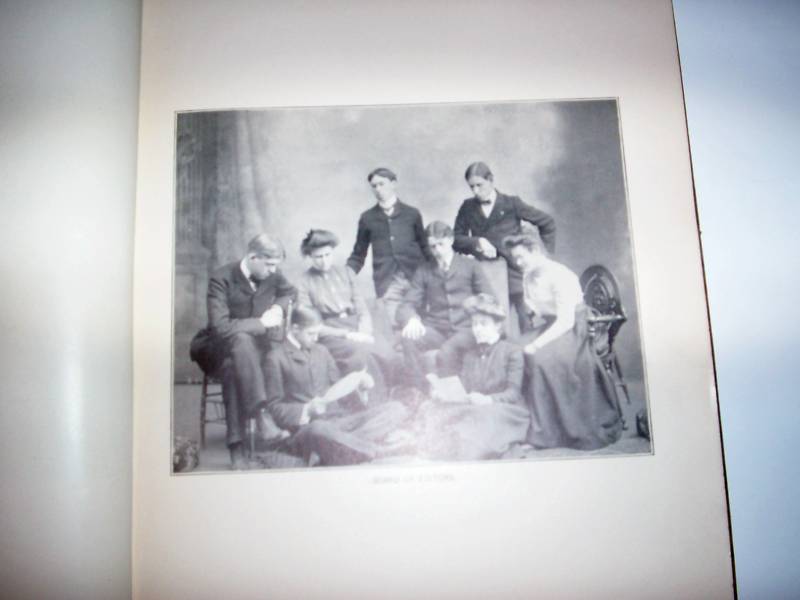
A typical sports pose is featured here - and in virtually all early Hope Street High School Yearbooks I've seen. Lovecraft would have been unimpressed. Perhaps fortelling the clash of RE Howard with HPL on "barbarian brutes", Lovecraft usually sided with brains over braun. Otherwise some vintage ads in the back of the eyarbook (sponsors). Lovecraft might easily have gotten a job with some of these agencies - but he didn't. He shunned "work". Lovecraft was 11, but in a few years he would stride the halls of this educational institution.


Sunday, May 30, 2010
Hope Street High School (c. 1901) Part 1
Lovecraft was only 11 at the time, but Hope Street High School was in full swing. The pride of Providence's educational system, I believe the image across from "Blue and White" is the principal. More images from an Ebayeum auction tomorrow.




Thursday, May 27, 2010
1897 class of (?) Hope High School


The Ebayeum seller states: I believe this Class of 1897 is from Providence "Hope Street High School" Providence, Rhode Island. It was with other items from that school in the same era. I can not say for 100% but perhaps someone would like to do the research. All the class members have been numbered and the names are on verso. The photo is in very good condition. The board is chipped as shown.
The images are pretty faint, but if this is Hope Street High School 1897, then it is the closest view yet of what a portion of it looked like. It would have been roughly 7 years before HPL attended.
Wednesday, May 26, 2010
1901 Hope Street High School Grad. Pamphlet

Of course this was years before HPl attended, but a nice image of the school. Note that the school year ends toward the end of June.
"Hope Street High School" "Commencement Exercises" Providence, Rhode Island. Wednesday Evening, June 26, 1901 at a quarter before eight o'clock. Pamphlet in very good condition with some soiling on the bottom edge. 4 pages.
Tomorrow, images of sudents...
Monday, April 19, 2010
Lovecraft Going to College
As virtually everyone who's read much about Lovecraft knows, he did not attend college. He apparently lied often about it. However, what if we made a different assumption? Just for theoretical and argument's sake?
He said he intended to matriculate - though he did not apparently have enough High School credits. He said his health collapsed. He said that math - algebra - was his downfall.
Hmm.
There seems to be some evidence that Lovecraft acquired a serious disease about the time that Providence had a pandemic that was renowned throughout many medical texts. We know that he was hell-bent for astronomical leather in 1906 scoring numerous milestones that were impressive. High School chemistry and physics - loaded with equations - were seemingly effortless to him. He did retake algebra, however. He says Geometry was little effort, and he frequently composed ad hoc star charts.
Before we can make any conclusions, Chrispy tracked down on Google the Brown University requirements for 1908 for entrance.
They are listed below.


In essence, all Lovecraft seemed to need was the principal of Hpe High School to give him a pass to take the entrance examinations on Thursday, 17 September 1908 at 8 AM in Wilson Hall.
So, what if the principal (It's assumed since he is listed on documents between 1902 and 1913, it was Charles Edward Dennis) gave him a pass? He would have been given credits for tutoring, and one supposes that someone with connections (Dr. Clark and Professor Winslow Upton), of elite status ('the grandson of Whipple Phillips'), might have got a pass to at least enter college and have a chance at advanced classes while catching up on requirements.
Documents exist that principal Dennis was 2nd Vice President of the Brown Univesity Teachers' Association (formed 1903). He and Upton would have known of each other, but this does not - of course - certify a conspiracy for Lovecraft to escape regimen and slip into college. But it at least allows for it, even if the probability is low.
So, maybe Lovecraft FAILED the test?
If he failed algebra, the whole plot would collapse. He would have to go back to High School, he would not be able to go to Brown University, and no amount of coercion by his defenders would be possible - not even the very politically powerful and former Dean of the Brown University, Winslow Upton.
OK, ok, it's all sheer speculation. Chrispy is sometimes the first to want to say Lovecraft lied or spun the truth, but time after time he is so blesse'd accurate when one checks the facts! Was he stating some form of the truth?
He said he intended to matriculate - though he did not apparently have enough High School credits. He said his health collapsed. He said that math - algebra - was his downfall.
Hmm.
There seems to be some evidence that Lovecraft acquired a serious disease about the time that Providence had a pandemic that was renowned throughout many medical texts. We know that he was hell-bent for astronomical leather in 1906 scoring numerous milestones that were impressive. High School chemistry and physics - loaded with equations - were seemingly effortless to him. He did retake algebra, however. He says Geometry was little effort, and he frequently composed ad hoc star charts.
Before we can make any conclusions, Chrispy tracked down on Google the Brown University requirements for 1908 for entrance.
They are listed below.
In essence, all Lovecraft seemed to need was the principal of Hpe High School to give him a pass to take the entrance examinations on Thursday, 17 September 1908 at 8 AM in Wilson Hall.
So, what if the principal (It's assumed since he is listed on documents between 1902 and 1913, it was Charles Edward Dennis) gave him a pass? He would have been given credits for tutoring, and one supposes that someone with connections (Dr. Clark and Professor Winslow Upton), of elite status ('the grandson of Whipple Phillips'), might have got a pass to at least enter college and have a chance at advanced classes while catching up on requirements.
Documents exist that principal Dennis was 2nd Vice President of the Brown Univesity Teachers' Association (formed 1903). He and Upton would have known of each other, but this does not - of course - certify a conspiracy for Lovecraft to escape regimen and slip into college. But it at least allows for it, even if the probability is low.
So, maybe Lovecraft FAILED the test?
If he failed algebra, the whole plot would collapse. He would have to go back to High School, he would not be able to go to Brown University, and no amount of coercion by his defenders would be possible - not even the very politically powerful and former Dean of the Brown University, Winslow Upton.
OK, ok, it's all sheer speculation. Chrispy is sometimes the first to want to say Lovecraft lied or spun the truth, but time after time he is so blesse'd accurate when one checks the facts! Was he stating some form of the truth?
Saturday, April 17, 2010
Hope Street High School Adminsitration (1903 ff)

Let's pause and discuss Charles Edward Tilley. Unknown how much Lovecraft knew of him, but they would have crossed paths.
In numerous journals, particularly as a member of The American Association of the Advancement of Science, Tilley of Hope Street High School is mentioned along with Winslow Upton of Brown University, etc.
In 1906's book for Phi Delta Theta we find he is still preeminent...

He has a major article in Education, Volume 27, p. 467, 1907. of which the first page is reporduced below ...

He was a Brown University Graduate ( CHARLES EDWARD TILLEY, AM Pedagogy, 1898-99.) and of Amherst College (Charles Edward Tilley Providence AB {Amherst College) 1892,Charles Edward Tilley, MA 1897 and CHARLES EDWARD TILLEY, MA, [Providence, R. L], son of Charles H. and Phebe A.)
In a Who's Who, His wife is listed as a suffrage movement member and more ...

Finally here is the list of the members of the AAAS in 1904's late edition (obviously published mid 1905 or so). Winslow Upton (Ladd Observatory and Lovecraft's mentor), John Howard Appleton (living on Angell Street), Alpheus Spring Packard (Jr) (Living on Angell Street), and Tilley (Hope High School) are all listed. Packard had just died (14 February 1905). These were all in Lovecraft's orbit.


Friday, April 16, 2010
Lovecraft's 1907 Physics Class?
{Chrispy found this in an old "How to Teach High School" Textbook. Uncertain if this was Lovecraft's teacher or not.} Link tied to today's blog title.
One thing to consider ae the equations mentioned. They are essentially applied algebraic equations, with the variables being physical constants rather than arbitrary numbers. Lovecraft indicated that he struggled with algebra and advanced mathematics, yet he did well in physics which is a mass of memorized and applied equations - even in the early 1900's.


One thing to consider ae the equations mentioned. They are essentially applied algebraic equations, with the variables being physical constants rather than arbitrary numbers. Lovecraft indicated that he struggled with algebra and advanced mathematics, yet he did well in physics which is a mass of memorized and applied equations - even in the early 1900's.
Monday, November 30, 2009
Lovecraft's High School Peers


Hope High School 1906. HPL was 16. These were people he would have seen in the hallways everyday - the days he attended. They saw him. What they thought of each other - well we must use our imagination.
Tuesday, September 15, 2009
Lillibridge
Recently, George noted that in one of my posts of a 1906 Hope High School year book, that "....marjorie lillibridge...." was listed. It reminded him that, "So THAT's where HPL got the name for the unfortunate newspaper reporter in THE HAUNTER OF THE DARK! // Sincerely, // George".
Thank you George.
Coincidentlally (?) as early as 1912, and as late as 1917, I've been able to find in the Providence City Directory (search google books) that at Beacon Avenue Primary School, Providence there was a Marjorie V. Lillibridge Assistant.
Chrispy hasn't examined the year book, however, if in 1906 "Marjorie" graduated, it seems a quick path of advancement to be an assistant at a Primary School in a mere 6 years or less. Just don't know.
Also, as to Edwin M Lillibridge, there is another odd coincidence:
# 11043859 LILLIBRIDGE EDWIN M
PROVIDENCE RHODE ISLAND (1 Dec 1942)
Private Air Corps RHODE ISLAND Army of the United States
Kent County RI
Archives Military Records
If the original Edwin was a real person, and Lovecraft accurately reported that an "Edwin M Lillibridge" did disappear, and IF thta Edwin was releated to some Marjorie, younger or older, then this Edwin would probably be a grandchild? Someone with more genealogical experience than Chrispy might have to decipher this, if you like "jig saw" puzzles.
Anyone have access to Ancestry.com?
Thursday, September 03, 2009
Hope High School Yearbook (1906) F (last)

____
I'd heard from another seller a long time ago that only one Hope High School Yearbook had a picture of Lovecraft. He was in and out of school so much, young Howard may not have been at school picture days.
It's interesting to know that a Munroe graduated in 1906 - probably related to Harold? When he did go to school, he undoubtedly passed these older kids in the hallways of Hope High School.
I suppose there are very, very few - if any others - left of these yearbooks. The last of their kind, this one being 103 years old and counting.


Subscribe to:
Posts (Atom)
Facebook:
