Showing posts with label 1911. Show all posts

Friday, August 19, 2011

Young Lovecraft and Astronomy

For this post, Chrispy will cast modesty aside. In earlier posts, Chrispy uncovered nearly the exact dates that Lovecraft almost died early in 1910. This was based on an obscure and sudden comet appearance, Comet 1910A.

He lost a great deal of weight, likely due to complications from measles and lung infection. He made a slow recovery, but was feeling well enough by the time of Halley's comet to go out at night by trolley and view it with his telescope and sketch it. With the help of several friends, mainly Steve and Dave, the precise point where he did his sketches was determined.

The articles below show the hysteria over Halley's comet which only phased Lovecraft in that he would have been appalled by what he would call ignorance. Note the "Comet pills" in the article below.

He went back and forth on Percival Lowell and his theory. This parallels public articles. Lowell was a powerful, popular figure and astronomers did not cross him lightly. However, as new telescopes went on line, Lowell's power faded, and astronomers were more vocal. This echoes the articles Lovecraft did in newspapers, as he mostly responded to the breaking news of astronomy.

What is becoming clear is that Lovecraft adored astronomy, but somehow he had a disconnect. He was a reasonably good observer, and a reasonably good writer conveying astronomical knowledge, but he did not become a good theoretician. Even with all the data he accumulated from hours of observations, Chrispy has not yet detected one original theory has been found in his writing - not even a bad one.

(His presentation of the theory of a ninth planet was bold, but it was a belief that many held based on a number of theories of the time. Lovecraft poeticized his Yuggoth, his near-contemporary Clyde Tombaugh searched for it.)

Can one fault his telescope? Not really. He read copious articles in professional and amateur journals. He associated with the staff at Ladd observatory, even using it from time to time. If he volunteered to crunch data, no evidence has been found.

This is not meant to be critical, as Lovecraft had a stack of issues between 1904 and 1911 that were daunting. He fell quickly behind in math comprehension - not a natural proclivity - and never recovered. He grasped other people's ideas rapidly, but could not use them to create his own. This may be an inherited Phillips trait, as all his successful Phillips' ancestors and relatives appeared to do just this. They were excellent managers (Chief Operating Officers of today) such as Theodore W Phillips and his adopted son also Theodore, or his grandfather who took other people's ideas and created wealth from them, or sadly, like Edwin his Uncle, saw opportunity but could not capitalize on it.

The articles below should expand into more readable views if you click them.


Tuesday, January 11, 2011

Edward H. Cole in Early 1911


Edward H. Cole (1892-1966)

Cole was established in the NAPA, and in 1914 reached out to both the north end of Providence to form a new amateur journalism club, and to Lovecraft to assist.

A few years before, Cole was a youthful novice, as this article shows. (circa age 19) His name is at the very bottom of the article. He was publishing The Bema out of Sommerville, Mass.

Friday, July 09, 2010

Samuel Loveman in the New York Times

Samuel Loveman in the New York Times. Fragments found online.
_____

Mr Sterling and Minor Poets
Published 4 June 1911

The New York Times Review of Books

It seems a singular anomaly that a poet of Mr. George Sterling's rank and responsibility should be referred to as a minor poet, and still more so that Mr. William Watson should be mentioned in the same connection. Mr. Sterling is not only a great poet, but inconceivably the greatest living, in either England or America. The sense of his art as a divine mission –

Remiss the ministry they bear
Who serve her with divided heart;
She stands reluctant to impart
Her strength to purpose, end, or share –

- stamps the high seriousness of one whom Shelley, Poe, and even Keats would have been the first to welcome. Let us honor the living as well as the dead.

Samuel Loveman.
Cleveland, Ohio, May 20.

_____

Latest Books: Published NYT 22 October 1922
"History and Biography"

Twenty-One Letters of Ambrose Bierce. By Samuel Loveman. 12 mo. Cleveland, George Kirk.

A series of unpublished letters addressed to Robert Loveman of Dalton, Ca., commencing with Oct. 17, 1908 and endng with Sept. 10, 1913.

{Note: Ambrose Bierce disappeared into Mexico after one last letter was sent on December 26, 1913 – CP}

_____
Hart Crane
Samuel Loveman

August 10, 1969, Sunday

Section: Book Review, Page BR22, 95 words

Though I am not given credit for having done so, I took the photograph of Hart Crane illustrating Helen Vendler's admirable front-cover review of John Unterecker's "Voyager," in your July 20 issue.
_____

TV: Making the Rounds With a Poet's Biographer; Cannel 13 Eavesdrops on Search for Crane 90-Minute Show Mixes Sounds and Sights
By JACK GOULD

September 23, 1966, Friday

Page 75, 382 words

AN unusual union of the literary and television worlds was demonstrated by National Educational Television last night on Channel 13. Prof. John Unterecker, a member of the English department in Columbia University's Graduate Faculties, is preparing a biography on Hart Crane, the poet, and N.E.T. hit upon the happy notion of having camera crews accompany him on his interviews. … Among those with whom Professor Unterecker talked were Malcolm Cowley, Samuel 'Loveman, ...

_____

Deaths; Cards of Thanks

October 10, 1937, Sunday

Section: GENERAL NEWS, LOST AND FOUND, PUBLIC NOTICES, SHIPPING AND MAILS, EDUCATION, OBITUARIES, WILLS, ESTATES, ARMY ORDERS, Page 29, 3985 words

…after a lingering Illness, Louis, Beloved husband of Marie (nee Burger) and devoted father of Joe, Sam, Malvani Loveman, Ben and Harry …

_____

SAMUEL LOVEMAN, 89, A POET,BOOK DEALER

May 18, 1976, Tuesday

Page 29, 155 words

Samuel Loveman, a retired book dealer and poet who was a youthfu protege of the writer Ambrose Bierce and a lifelong friend of the poet Hart Crane, died Friday in the Jewish Home and Hospital for the Aged. He was 89 years old.

Saturday, July 03, 2010

A Piece of Vintage High School Ephemera (1911)


Not Lovecraftian, but shows a similar High School and a special speaking program. Undoubtedly Hope Street High School would not have been shown up by this school, so Lovecraft could have availed himself of a little "culture" had he wanted to do so.

Thursday, May 27, 2010

Susan Lovecraft's Annual Income (1911)


Her personal income:
Lovecraft Sarah S // 1300 // 21 45
(page 309, Providence Tax Book)

_____
Howard Lovecraft is not listed - that I can find.

Friday, October 31, 2008

Happy Halloween (1911)

We know a few things about the 21 year old Lovecraft in 1911. He loved cats, especially black cats. He would have been appalled at any hint of superstition, magic, or that Halloween was anything special.

It's fascinating to see that 1911 was the year of the "witch in red". Here are several examples, all from 1911.


Monday, November 13, 2006

Harry Houdini's 1911 Sea Monster - a Lovecraft Influence?

One always wonders about what Lovecraft may have absorbed to create Dagon. We are sure that Irving Cobb's FishHead and at least one vivid dream came together to create Dagon. Still, what made him think of the Philistine FishGod? *

In any event, here is the text from the new Houdini book. **

The procession started on the Long Wharf of Boston Harbor and continued through the winding streets to Keiths Theatre. Crowds of people followed the bizarre parade, others just stood on the sidewalk and watched in awe as Houdini's next great challenge was publicly displayed. "It" was a giant 1,600 pound sea monster that had been fished out of the ocean, a "what is it" that locals had identified as a cross between a whale and an octopus. Ten prominent Boston businessmen had challenged Houdini to be fettered with handcuffs and leg irons and escape from the hollowed-out "belly of the beast.'

The scene onstage on September 26, 1911 was unbelievable. It took a dozen stagehands to carry out the "turtle-tortoise-fish or whatever it is," and turn it on its back on the center of the stage. Its abdomen had been sliced open, affixed with metal eyelets, which held a long thread of steel chain. Before the escape was attempted, Houdini was forced to sign a document that would release the owners of this monster from any liability should Houdini fail the test.

Then the steel chain was slackened, and Houdini crawled into the carcass, pausing to spray some strong perfume where his head would lie. He gave a signal, and handcuffs and leg irons were fastened to him. Then the committee went to work. Smiling through their labor, they tightened the chain, passed it around the creature's back, and secured it with locks. The cabinet was then placed around the beast and the orchestra struck up.

After fifteen minutes, the screens of the cabinet were thrown open, and there was Houdini, "grease-covered, pallid and perspiring," holding the handcuffs and leg irons aloft in triumph. On examination, the beast was as securely locked as it had been before. Houdini was not unscathed. His first words were to the stagehands, requesting them to open the windows and give him some air. Houdini had underestimated the toxicity of the arsenic solution that the taxidermist had used to preserve the sea monster, and, locked inside, he had been adversely affected by the fumes.

From: The Secret Life of Houdini: The Making of America's First Superhero, William Kalush and Larry Sloman, Atria Books, NY, 2006, p. 267


* It really was not a Fish God, but 19th century etymology mistook dagon as a metaphor or semitic root word of fish and god.

** The Fortean Group with T. Peter Park and Loren Coleman, among other notables, are researching this anecdote for fuller references in newspapers or other literature. Stay Tuned!

Sunday, November 12, 2006

1911 Sea Beast

In 1911, Harry Houdini was manacled and slipped inside the carcass of a "sea monster" that had washed up on a beach near Boston (Cape Cod). The unidentified corpse was then sewn shut and chain was wrapped around it. Houdini escaped, although the fumes of the rotting beast mixed with arsenic (which was used to preserve it for the stunt) very nearly killed him. Fortunately, Houdini was able to stay conscious, and managed to escape from his organic prison.

Lovecraft was always on the watch for sea creature stories. I wonder if this deteriorated sea thing influenced the writing of Dagon? *

* It is generally recognized that HPL dreamed most of the story and that also Irving Cobb's story of 1913 "Fishhead" were primary influences. Still ... HPL often mulled over an idea for years before it came to fruition.

Saturday, April 15, 2006

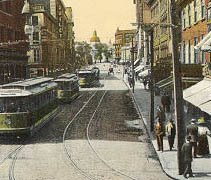
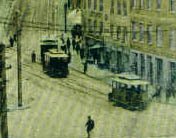
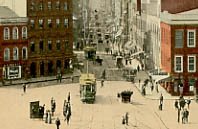
Time Travel with HPL: 1911


^Weybosett


^College Hill


^Westminster

"He celebrated his twenty-first birthday - 20 August 1911 - by riding the electric trolley cars all day, going through the states of Connecticut and Massachusetts before coming home."

Note the trolley cars of the era and recall that HPL lived on "College Hill".

1 A Dreamer and a Visionary: H P Lovecraft in his Time. ST Joshi, Liverpool, 2001, p. 69

Followers

Blog Archive

Facebook:

Google Analytics