Showing posts with label 1906. Show all posts

Friday, January 04, 2013

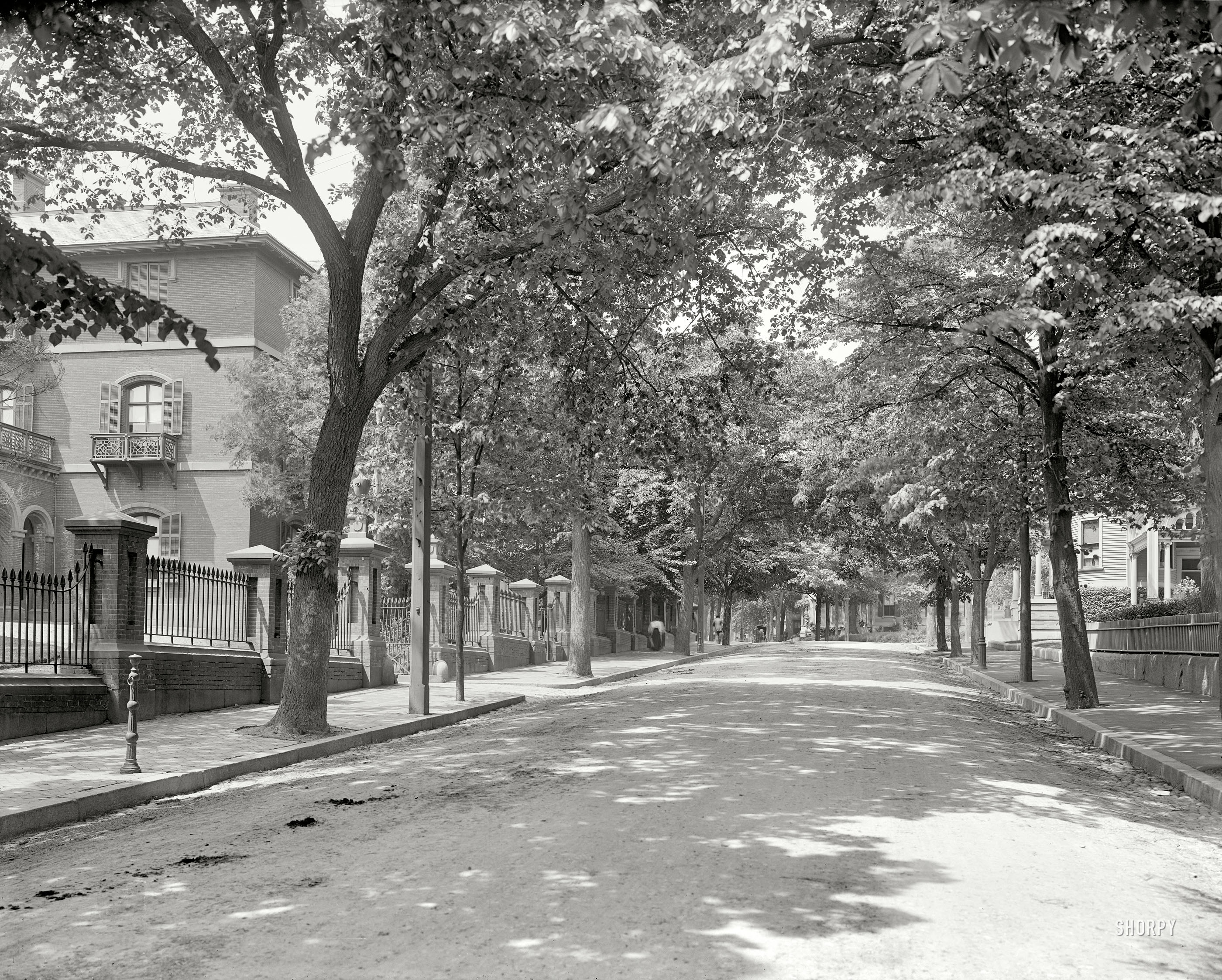
Prospect Street, 1906.

This in from a reader:

 What about this one?  It's much closer to where HPL was actually living at the time.


Circa 1906. "Prospect Street. Providence, Rhode Island."

For more Prospect Street stuff, check out this link back:

140 Prospect Street

Thursday, June 10, 2010

Lovecraft in the Scientific American (16 July 1906)


Ivan has been so kind (and patient) as I was able to get this posted.

The text from the auction:

SCIENTIFIC AMERICAN
August 25, 1906
Featuring
H.P. Lovecraft's
First Published Letter!

Hello! Up for auction is a copy of the August 25th, 1906 issue of Scientific American, featuring the FIRST PUBLISHED LETTER by the one and only H.P. Lovecraft!

In the letter, a young Lovecraft describes a way in which astronomers might discover planets outside the known solar system -- which, at the time, ended with Neptune. Interestingly, the methods described by the author would be used two years later to discover Pluto. And that same year, Pluto would play an important role in Lovecraft's great short story "A Whisperer in the Darkness."

Lovecraft famously said that the greatest fear is the fear of the unknown. But what I find particularly interesting about this letter is that it shatters the idea that Lovecraft governed his life by this credo. Indeed, a narrator in one of his stories might use the methods described in the letter and then run screaming from his telescope when the search uncovered some nameless horror lurking just behind Neptune. But Lovecraft himself embraced the search for knowledge and welcomed opportunities to expand human understanding of the cosmos. This letter demonstrates that there was more to the man than merely his popular reputation.

As such, this 100-year-old piece of Lovecraftiana is a must-have for serious collectors, and is sure to be a jewel in anyone's collection.

This copy of Scientific American is in excellent condition. The pages are still supple, shiny and bright, with very little discoloration. There are no tears or missing pages. The spine has some wear, as illustrated in the photos. Some of the string originally used to hold together the binding is exposed, but the glue edge -- which provided the binding's real strength -- is uncompromised and maintains its structural integrity. In all, this is one of the nicest copies I've seen in a long time. Remember, it's over 100 years old! It's amazing it survived at all... But to be in this condition, one can only imagine that care taken by the previous owner.

Monday, April 12, 2010

What is a "Sixe's Thermometer"?

Lovecraft mentions he used a standard thermometer, and a Sixe's thermometer. In the U.S. it has been abbreviated, sometimes, to Six's thermometer. HPL used the expanded spelling.


Above is a modern item, and shows: A Maximum Minimum thermometer. The scales are Fahrenheit on the inside of the U and Celsius on the outside. The current temperature is 23 degrees Celsius, The maximum recorded is 25, and the minimum is 15, both read from the base of the small markers in each arm of the U tube. The bulbs are hidden by a plastic housing.

These were not easy to maintain, and may have easily caused Lovecraft to be late for school. He may have sometimes had a mercury mess. *

The Sixe's thermometer is notoriously known for separations in the mercury column, in particular after shipment, though accidental knocks have been known causes as well. Separations can usually be corrected by swinging the thermometer like a large old school fever thermometer. The centrifugal force will then force the mercury together again. Should the markers be partly buried in the mercury they can either be pulled up again with the magnet or put to a temperature change that leaves the markers uncovered. It is however important NOT to use a magnet to pull up markers in the push button type because there's a risk of damaging the weak magnet behind the scale or magnetize the steel in the markers with equal fatal consequences - either weakening or enhancing the pulling force against the capillary tube on all or part of the scale.

How it works: ... consists of a U-shaped capillary tube with two separate temperature readings, one for the maximum temperature and one for the minimum temperature. There are bulbs at the top of each arm of the U-shaped tube. The one at the top of the minimum reading scale contains alcohol, the other contains a vacuum or low pressure alcohol vapour.

In the bend of the U is a section of mercury element mercury which is pushed around the tube by the expansion and contraction of the alcohol in the first bulb. It is the alcohol which measures the temperature, the mercury indicates the temperature reading on both scales.

At any given time the reading of the mercury should be the same on both the maximum and minimum scales. If not then the instrument scales are not correctly positioned.

As the mercury moves it pushes 2 small steel markers which are sprung into the tube. They record the furthest point reached by the mercury in each arm of the tube. When the temperature reverses and the mercury is moved in the opposite direction by the expansion or contraction of the alcohol, the sprung markers remain in the tube at the furthest position they have been pushed by the mercury. They thus record the extremes of temperature experienced by the device since it was last reset.


Chrispy was unable to find a 1906 style thermometer, but here is one from 1869.


We should also discuss the other kind of thermometer. Today, we take temperatures by shining a little light and reading an LED (light emitting diode). Not so in the days of slide rules. A glass tube, sealed on both ends, was filled with mercury and scored with degree marks. As it got warmer, the mercury expanded, and as it cooled it got smaller. These were relatively fragile, and if you handled them with cold, or wet fingers, you got a *whoops* with a resulting shatter of glass and a hundred tiny droplets of silver mercury that rolled as if possessed. One cleanup was to sprinkle silver dust which immediately absorbed the droplets and amalgamated the particles and made clean up easy. Beware if you had a 14K gold ring, for it would forever silverize the gold. If you had a keen eye, you could easily read 1/100-th of a degree in a very accurate (precise) thermometer.
_____

*Mercury. Chrispy, from an early age was fascinated with science. He accompanied his mother as she cleaned offices, and back in the 60's (I'm sure the statute of limitations has expired, and all adults are now deceased) he would sneak to the dentist's bench and play with the little beads of mercury. Oh how they rolled, and dust beaded up on theri surface, and if you pushed them together, they merged ! The metal did appear alive to that little boy.

In the 1980's, in a lab I worked in, the employees often broke the mercury thermometers. (Did they ever!) When I became lab manager, and tired of chasing little droplets of mercury (since I was the designated person to chase the droplets and who actually had a chemistry degree), I switched everyone to the then-new inexpensive digital thermometers (which they also destroyed on occassion).

In Lovecraft's day, mercury was "quicksilver" and commonly used in many purposes, but mostly in dental amalgams and thermometers. If he was like any other scientist of his era, he probably knew the minimal risks and cleaned up lots of mercury spills. Glass is fragile, and accidents happen.

Mercury is a neurotoxin, and the vapors do readily evaporate and can be respirated. Do NOT use mercury. There are so many safer ways to do the job these days.

No, I don't think Lovecraft was in any way harmed if he handled mercury. I think that upon this subject I can be sure, it did not influence his weird tales.

Saturday, April 10, 2010

Lovecraft's Meteorological Work

In the 1906 Meteorological Report, we read that part of the equipment is: "Rain Guage by Queen and Co." Are there implications for simply having this device?

Well, one wonders if Lovecraft's work were a game, an attempt to play at astronomy and meteorology before starting his carer? - or something of a more serious nature? Before we delve deeply into this, Chrispy found a St. Louis engineering and planning book from 1911.

It reads in part about the complexities of controlling rain runoff in an urban environment (and mentions the Queen and Co. rain guages). See text below. These values in St. Louis were being used for urban expansion planning, and drainage work. One suspects similar work was being done in the sprawling and teaming Providence, and lots of data was needed.

This was modern, 20th century work, and Lovecraft was being a real scientist - if his work was actually being used by planners. This was true meteorology, and would have been possibly sanctioned by Brown University (Upton?). The station was located on top of the Rhode Island Journal Bldg., and while the years before WWI were placid, one suspects that not just anyone climbed upon the roof of a prestigious newspaper building without some permission and sanction.

_____

Experimental Work.—The method of computing runoff outlined above is theoretically correct, but the values of "p," the percentage of runoff, and the critical time for the remote inlet, are based on a few published observations which arc usually incomplete and of doubtful value when applied to local conditions. In fact, the whole subject of rainfall and runoff in general is a dark spot in engineering literature and knowledge, and it is only very recently that engineers have awakened to the necessity of obtaining more accurate information on this subject.

The extraordinary amount of sewer work now in progress in St. Louis has brought forcibly home to the designers the fact that a little more data might result in a great saving in money, either in first cost of the sewer system, or in damages should the sewers prove insufficient. For this reason, a series of observations has been undertaken which is expected to give

1st. More accurate records of intensity of precipitation.
2nd. Approximate values of the percentage of runoff under various conditions.
3rd. Approximate values of the critical time for street inlets.
4th. An idea of the area covered, at any one time, by storms of various intensities.

To cover the first and fourth points, a series of rain gauge stations has been established. The gauges now installed arc: H Frieze tipping bucket recording rain gauges; M Queen and Company automatic recording rain gauges; o Standard rain gauges.

In addition, the records from the Frieze instruments of the U. S. Weather Bureau Station and the St. Louis University Station are received, giving in all 8 automatic and 5 standard machines. To secure the data on runoff, 10 Bristol automatic recording water level gauges have been installed in the sewers.


Friday, April 09, 2010

Ives Difraction Spectroscope


Chrispy found on-line an old 1906 factory catalog for a similar items as HPL used in 1906-7.

"On Dec. 24, 1906 ... procured a diffraction spectroscope by Ives. The object was to observe the condition of the atmosphere with respect to aquous vapor. It is well known that atmospheric moisture causes a dark shaded band, called the "Rain Band", in the solar spectrum nead the "D" line. This band, with respect to intensity, is observed daily, and is an index to coming rain, far superior to the hygrometer ...", H P Lovecraft in his 1906 "Third Annual Report of the Prov. Meteorological Station"

The C-137 model was the Ives Innovative Spectrocope (pictured) No. 1, was $45.00. In addition, one might need extra eyepieces at $2.00, or cross line eye piece for $6.00.

Version 2 was the same as No. 1 with the addition of an extra front, circular screen, and tripod focusing glass. Cost $10.50.

These were staggering sums of money. Except for some meager money that MIGHT have come from writing newspaper articles, he had only his $2500.00 inheritance money (from 1904), and some (?) incidental incomes.

The timing of Christmas Eve is probably not a coincidence, but did he buy it, did Susan buy it, did Dr. Clark, or Professor Upton, or some other agency purchase this new and expensive device? Alas, we shall not know except to agree that this was not only expensive, but high grade equipment Lovecraft was using. It was not to be trifled with, and HPL knew what he was doing.

While this brochure is from Chicago, one suspects that the one out of Boston or elsewhere would have read with similar information. Lovecraft would have been eying for some time, one suspects.

As a comparison, here are some 1906 statistics on wages and costs.
The average wage in the U.S. was 22 cents per hour.
The average U.S. worker made between $200 and $400 per year .

A competent accountant could expect to earn $2000 per year,
a dentist $2,500 per year, a veterinarian between $1,500 and $4,000 per year, and a mechanical engineer about $5,000 per year.

Sugar cost four cents a pound.
Eggs were fourteen cents a dozen.
Coffee was fifteen cents a pound.

Thursday, April 08, 2010

Lovecraft's Meteorological Equipment (1906) Part A

In his "Third Annual Report of the Prov. Meteorological Station: 1906" of 16 January 1907, Lovecraft declares he has:

(1) Mercurial Barometer by Spooner
(2) Sixe's Thermometer by Taylor
(3) Rain Guage by Queen & Co.
(4) Wind Vane by Gage & Co.
(5) Storm Glass by Lage
(6) Stan[dard] Thermometer by Wilder
(7) Diffraction Spectroscope by Ives

What is all this stuff, and were they his - or owned by someone else like the Providence Journal?

Let us take (1). This is a barometer devised by Spooner and created by SPOONER BAROMETER OF BOSTON, MASSACHUSETTS. It is described as "elongated form in walnut with ebony trim. The receptacle base with shaped wood. The dial at top with thermometer on right side and barometer on left." There were no doubt many versions since it's late 19th century cration.

The design remained relatively unchanged over the years (since 1850?). Here is another description: Stick Barometer E. & C. Spooner, Boston, American, ca 1850, of walnut and ebonized walnut. Telescope form, manufactured by E.C. Spooner, Boston. Curved molded crest above a silvered register with barometer and thermometer engraved The/Storm King Barometer/Warranted Correct/Manufactured/and Sold by/E.C. Spooner Boston; ht. 42 in.

We do not know what year or model this is, but it would look a lot like this image.


Thursday, February 11, 2010

1906 Alaska Lecture at Brown University


No indications that HPL attended this as a teenager. There are a few vague coincidences metioning Alaska later in his writings. Perhaps the only thing this long ago card proves is that "Alaska" was "in the air" during 1906.

It also shows how many available lectures were at Brown University that Lovecraft could have, and sometimes did attend.
_____

The 1932 story "The Horror in the Museum" breifly mentions an Alaskan expedition bringing back a relic of Rhan-Tegoth.
_____
A letter snipet, "...Alaska also captivated my imagination — all the more so because my constitution could never endure cold (I can't go out when it's under 20°)... " curcal 1932-1934.
_____
Ch. 7, At the Mountains of Madness, "...the approximate world of today appeared quite clearly despite the linkage of Alaska with Siberia...".

Thursday, February 04, 2010

Tracking the Elusive Lovecraft: "My Sweet Elaine" with "Mockingbird".

HPL declares in a rare rhapsodic outburst [To Galpin/Galomo, 31 August 1921], "...the voices of men shall sing the songs of boys - the songs of fifteen years ago - "In the Golden Autumn Time, My Sweet Elaine", "When the Mocking Bird is Singing in the Wild Wood" ..." and [To Kleiner 11 August 1921] "we shall go back to 1906 ... howling the old cheap popular songs of 1906..."

Never satisfied and seemingly with too much capacity for the trivial, Chrispy sought out for a date. When did all this bloody singing take place?? - assuming Lovecraft wasn't tripping on bad coffee.

Well, "Da Google" comes to the rescue. How did researchers ever research Lovecraft without it? Heh.

I tracked down the obscure, "In the golden autumn time, my sweet Elaine" to its inception as a Victor (double) release 9 January 1906 of a Stephen R. Henry composed song. See below.

Link:

A-2991 1/9/1906 In the golden autumn time, my sweet Elaine John H. Bieling ; Harry Macdonough ; Haydn Quartet Male vocal quartet, with vocal soloists and orchestra
C-2991 1/9/1906 In the golden autumn time, my sweet Elaine John H. Bieling ; Harry Macdonough ; Haydn Quartet Male vocal quartet, with vocal soloists and orchestra
_____

Now he has misremembered slightly the other song which Chrispy found as another Victor recording entitled, "When the mocking birds are singing in the wildwood" by composer H. B. Blanke.

The notes are:
Link

2/9/1906 (Philadelphia, Pennsylvania [unconfirmed]) 1 Master Victor 4665 8" disc
Authors and Composers Notes ... H. B. Blanke (composer) Arthur J. Lamb (lyricist)
Primary Performer Notes Harry Macdonough (vocalist: tenor vocal)
Matrix E-3088

US Billboard 6 - Apr 1906 (1 week)
_____

So, assuming that HPL did recollect the memory correctly - and he is proven over and over correct (unless he's caught spinning the facts, spin-meister that he was) we shall have to agree he was correct. They bicycled out 8 or 9 miles into Massachusetts singing melodies as they went. Since, it's unlikely they built any club houses in mid-winter, these song were playing and caught on through the late Spring and Summer of 1906. This would be pretty close to the date that Lovecraft gives for their ages - but he would have been 16 years old on 20 August 1906, a bit younger than he admits: [To Kleiner, op cit] "...we were boys of 16 or 17".

He also recalls the precise date of the new club formation as [To Kleiner, op cit] "... which had its last reorganisation on April 11, 1906 ..."
_____

So, dear Lovecraftians, we have reasonably independent data that supports Lovecraft's memories on this one.

The latest of the two songs mentioned released February 1906 and hit Billboard's top in April for one week, and HPL recalls 11 April 1906 as the reorganisation meeting of the clubhouse expedition. Following that, they must have selected the far off Rehoboth location, solicited James Kay's help, and through that Summer of 1906 as HPL was turning 16 'they' rebuilt an old shack into a country club and had a grand time.

And as we see, it was still standing and intact on Monday, August 8, 1921.

Monday, November 30, 2009

Lovecraft's High School Peers


Hope High School 1906. HPL was 16. These were people he would have seen in the hallways everyday - the days he attended. They saw him. What they thought of each other - well we must use our imagination.

Thursday, September 03, 2009

Hope High School Yearbook (1906) F (last)


____

I'd heard from another seller a long time ago that only one Hope High School Yearbook had a picture of Lovecraft. He was in and out of school so much, young Howard may not have been at school picture days.

It's interesting to know that a Munroe graduated in 1906 - probably related to Harold? When he did go to school, he undoubtedly passed these older kids in the hallways of Hope High School.

I suppose there are very, very few - if any others - left of these yearbooks. The last of their kind, this one being 103 years old and counting.

Hope High School Yearbook (1906) E

Hope High School Yearbook (1906) D

Hope High School Yearbook (1906) C

Hope High School Yearbook (1906) B

Lovecraft's High School Year Book (1906) A

For $75 this can be yours at Ebay.
_____
{Chrispy has the 1905 Yearbook. I hope one of you can get this and we can compare notes!)

The seller states:

1906 Hope High School Annual Blue and White with wonderful photographs and text about the young women and men, including faculty, students, sports, activities, graphics, and literature. Seniors are photographed in groups and get detailed personal paragraphs. Great old photography, literature, and beautiful design!
Of Special Note: > Photographed sports include football, basketball, hockey, track, and baseball. The baseball team went 14-2!

Names of the graduating seniors include: edith angell, lucy arbuckle, donald babcock, katherien baggott, charlotte barry, gwendolyn blodgett, bessie bloom, john brennan, mildred brown, mabel bushell, myra capron, frances carroll, edith cobb, estelle collier, edith collins, herman copeland, dana crawford, esther cristy, alice crocker, edith daniels, earl davis, earl dawley, katherine dean, richard eayres, clarence fletcher, william freeman, bertha furlong, anna gomberg, liela gupta, ethel griffin, arthur ham, gardner harding, meritta hawkins, elmer horton, lucile jacobs, donald jackson, grace kennedy, george laird, grace lee, sarah levalley, caroline lewis, marjorie lillibridge, william lynn, frank mcevoy, keith mercer, amrie metzger,edward moran, c. marguerite munroe, nellie nelson, charles neves, olive o'connor, dorothea ruoff, hope sessions, rosamond shaw, alexander stoneman, mary suffa, arthur sundlun, howard taber, leila tucker, anna wallace, margaret westcott, loise williams, herbert wray.

Photographed athletes include: Football: kilton, mcnaught, andrews, babcock, russ, harding, nisbet, kean, budlong, longhran, adn donahue; Baskeball: captain marsh, nisbet, donahue, budlong, and babcock; Hockey: bullock, chapin, donahue, brice, brice, bosworth, budlong, nisbet, and eayrs; Baseball: fred budlong, bliss, kennedy, donahue, w. budlong, a. budlong, lougharan, feely, tingley, kilton, and webste. Track: captain seabury, manager harkness, allen, bullock, randall, budlong, loughran, salisbury, and nisbet.

Photographed Yearbook Editors include: stuart horton, edith angell, donald babcock, herman copeland, esther cristy, dana crawford, earl davis, gardner harding, william lynn, leila tucker, amrgaret westcott, and donald jackson.

Local Advertisement includes: Boar's head Grocery, Dawson Bicycles, John Metzger Apothecary, What Cheer Stables, Albert Miller Bonds, Wright and Ditson Sports Wear, L. P. Eklund Tailoring, H. B. Cranshaw Boats and Canoes, Barstows Agawam Hunt Club, Meek Pharmacy, Phillip Tally Merchant tailor, Browning and King Haberdashery, Rafael Catino Shoe Making and Repair, Stoneman & Grossman Grocery, Beech Grove Canoe House, Peter Maynard Shaving Rooms, A. S. Doane Fish, Gates & Wilson Westminster Street Shirtwear, Lyman's Seaconnet Hotel, Richard Jenks Mechanical Engineer, Preston & Rounds Booksellers, J. G. McIntosh Carriages, J. B. Brennan newsdealer and Tobacconist, Irons and Russell Emblems, Calef Brothers Marketmen, Elsbree & Valleau Button Gloves, Herbert Haynes Apothecary, T. J. Johnston, Flowers, Joseph Mann Piano, , and many others ...........

Good to very good condition hardback issue complete with with clean pages, and no must or mildew or smoke effects.

Wonderful beautifully done annual giving a true historic look at the Providence Rhode Island and its promising young women and men at Hope during the Theodore Roosevelt years. Just waiting for a nice home!
Monday, July 20, 2009

A 1906 Providence Calendar

Who knows? This may have hung in the Lovecraft household. Each image should be expandable if you click - it should expand in a new window. The pictures would all have been as familiar to HPL as the back of his hand. Note August and think of HPL's 16th birthday!


Description:
1906 ‘THE PROVIDENCE CALENDAR’

PROVIDENCE, RHODE ISLAND

This beautifully illustrated 1906 calendar hails from Providence R.I.

'THE PROVIDENCE CALENDAR' is an elegant ‘TURN OF THE CENTURY’ work of art. This is expressed in its cover design of a late Victorian-era woman and varied ‘pen-and-ink’ style foliage illustrations that appear on each month’s page as background for the calendar month and accompanying photos of prominent Providence, Rhode Island buildings, landmarks, parks, memorials, street scenes, etc.

The opposite side of the front cover is inscripted:

PUBLISHED FOR
RHODE ISLAND NEWS COMPANY
PROVIDENCE, R.I.


Copyrighted 1905
By
EARLE C. TITUS

Press of R.S. Peck & Co.

By the way, Earle C. Titus who is listed as the ‘copyrighter’ above was the artist of the foliage illustrations. His signature is seen at the bottom right of the ‘January’ page.

The calendar measures 9½” x 12” and is complete, i.e. contains pages for all 12 months. The front cover has some water stains. Some of the pages show soiling, some with minor frayed edges. The back cover is barely in existence but can be replaced since the calendar is hole-punched and bound at the top with a green cord. For the most part, the artwork within the borders of each calendar page is virtually unscathed.

Friday, May 22, 2009

Lovecraft's First Letter?


Though Chrispy patrols the auction sites, I can't see it all. Thank you, Ivan! Here is probably Lovecraft's first published letter, and most assuredly one of his most notable scientific achievements. As a teenager (HPL born 20 Aug 1890) would have been just shy of 16 when he sent off his letter) he was decidedly intent on a career in astronomy. Taken under the wing of the great Upton, he was not only introduced to celebrities such as Percivel Lowell, but also tapped to write astronomical columns for local newspapers. He was well on his way, except for three failings. He was poor in math, sickly, and his means of independent wealth seized from him when his grandfather died.

Again thanks to Ivan and enjoy these images of Lovecraft's first published scientific letter.


Thursday, January 01, 2009

Happy New Year


From 1906
Lovecraft would have been 16.

{Promoting a business at Pine and Hay Streets, this is a New year's Ad Post Card. It pictures places places Lovecraft frequented all his life - local icons}

Thursday, December 25, 2008

Happy Holidays!

From 1906.
No connection to Lovecraft, just a cool vintage card.
Lovecraft would have been 16.

Wednesday, December 03, 2008

1906 Meteor Report

Lovecraft probably read of this report, as he did follow the NYT. It comes from the very cool site, Water UFO: http://www.waterufo.net/nodate.php?date=1067_1946


October 30, 1906

A SHOWER OF METEORS AROUND THE ST. ANDREW
One, Weighing Tons, Hit the Sea a Mile Away.
A GREAT SHOW, EVEN BY DAY
Chief Officer Thinks Such Messengers from the Blue Have Sent Many a Ship Down.

When the Phoenix Line steamship St. Andrew arrived from Antwerp yesterday, Capt. Fitzgerald reported that the steamer had passed through a meteoric shower at 4:30 o'clock on Tuesday about 600 miles northeast of Cape Race. The largest meteor observed fell into the sea less than a mile away. Had it struck the St. Andrew, all hands would have perished.

Yesterday afternoon Chief Officer V. E. Spencer, who was on the bridge when the meteors appeared, told what he saw there.

“On Tuesday afternoon," said Mr. Spencer, "the weather was clear and bright, although there was little sunshine. Just after one bell, 4:30 o’clock, I saw three meteors fall into the water dead ahead of the ship one after another at a distance of about five miles. Although it was daylight, they left a red streak in the air from zenith to the horizon.

"Simultaneously the third engineer shouted to me. I then saw a huge meteor on the port beam falling in a zigzag manner less than a mile away to the southward.

“We could distinctly hear the hissing of the water as it touched. It fell with a rocking motion, leaving a broad red streak in its wake. The meteor must have weighed several tons and appeared to be from 10 to 15 feet in diameter. It was saucer shaped, which probably accounted for the peculiar rocking motion.

“When the mass of metal struck the water, the spray and steam rose to a height of at least forty feet, and for a few moments looked like the mouth of a crater. If it had been night, the meteor would have illuminated the sea for fifty or sixty miles. The hissing sound, like escaping steam when it struck the water, was so loud that the chief engineer turned out of his berth and came on deck, thinking the sound came from the engine room. I have seen meteors all over the world, but never such a large one as this."

Asked what would have happened if the meteor tumbled on the St. Andrew, Mr. Spencer said:

"The ship would have been burned out immediately and every soul on board destroyed. I have no doubt that many of the vessels which have been lost at sea in apparently fine weather have been destroyed by falling meteors."

Capt. Russ of the Hamburg-American steamer Brazilia, which arrived yesterday about the same time as the St. Andrew, reported having seen a large meteor at 7 P.M. on Tuesday, Oct. 30, in latitude 47 degrees north and longitude 48 degrees west. This is believed to have been part of the intermittent meteoric shower observed by the St. Andrew earlier in the evening.

This is the original reference: The New York Times, November 5, 1906, p. 1

Followers

Blog Archive

Facebook:

Google Analytics