Showing posts with label John Howard Appleton. Show all posts

Saturday, April 17, 2010

Hope Street High School Adminsitration (1903 ff)


Let's pause and discuss Charles Edward Tilley. Unknown how much Lovecraft knew of him, but they would have crossed paths.

In numerous journals, particularly as a member of The American Association of the Advancement of Science, Tilley of Hope Street High School is mentioned along with Winslow Upton of Brown University, etc.

In 1906's book for Phi Delta Theta we find he is still preeminent...


He has a major article in Education, Volume 27, p. 467, 1907. of which the first page is reporduced below ...


He was a Brown University Graduate ( CHARLES EDWARD TILLEY, AM Pedagogy, 1898-99.) and of Amherst College (Charles Edward Tilley Providence AB {Amherst College) 1892,Charles Edward Tilley, MA 1897 and CHARLES EDWARD TILLEY, MA, [Providence, R. L], son of Charles H. and Phebe A.)


In a Who's Who, His wife is listed as a suffrage movement member and more ...


Finally here is the list of the members of the AAAS in 1904's late edition (obviously published mid 1905 or so). Winslow Upton (Ladd Observatory and Lovecraft's mentor), John Howard Appleton (living on Angell Street), Alpheus Spring Packard (Jr) (Living on Angell Street), and Tilley (Hope High School) are all listed. Packard had just died (14 February 1905). These were all in Lovecraft's orbit.


Wednesday, March 03, 2010

Edward Francis Gamwell


Above is an example of Gamwell's first edited newsletter, this one being dated of 11 May 1895. The entirety of Volume 3 is now online.
_____

Chrispy was able to find a few scattered notes in long ago documents for Gamwell.

ST Joshi notes in his Lovecraft Encyclopedia, "Edward Francis Gamwell (1869-1936) … received the A.B. from Brown University in 1894. Gamwell was city editor of the Cambridge (Mass.) Chronicle (1896-1901), editor and proprietor of the Cambridge Tribune (1901-1912), and editor of the Budget and American Cultivator, both published from Boston (1913-1915). Thereafter, he engaged in independent commercial writing and advertising. He was editor of An Historic Guide to Cambridge (1907).

To this we can add some information about the somewhat missing years of 1894-1896 as gleaned from two online copies of the "Historical Catologue of Brown University , 1764-1914" and "… 1764-1914". These can be found online at Google Books under the link: (www.archive.org), "texts".

In the 1904 edition, we have additional and slightly differing information for Gamwell (p.411-412): GAMWELL, EDWARD FRANCIS, A.B. Instructor English, Brown University, 1894-95. Managing editor Atlantic medical weekly, Providence, R. I., 1894-96; City editor Chronicle, Cambridge, Mass., 1896-1901; editor and proprietor Tribune, Cambridge, Mass., 1901- ?. Author various articles in newspapers and magazines. Address, 438 Broadway, Cambridge, Mass.

In the upate, ten years later we have this:

In the 1914 edition we find (p.318, 1894 graduates, for the year ending 1914)
GAMWELL, EDWARD FRANCIS, A.B. Instructor English Brown University
1894-95. Managing editor Atlantic Medical Weekly, Providence, R. I., 1894-96;
City editor Chronicle, Cambridge, Mass., 1896-1901; editor and proprietor Tribune,
Cambridge, Mass., 1901-12; associate editor Budget and American Cultivator,
Boston, Mass., 1913-; *. B. K.; address, 438 Broadway, Cambridge, Mass.

Under the heading "Officers of Instruction" (p.42) there is an Edward Francis Gamwell listed with these notes: A.M. Assistant, Rhetoric, 1894-1895.

_____

Minutes of the Rhode Island Baptist anniversaries, p.116, mentions an Edward F. Gamwell as a "life member" of the Rhode Island Baptist State Convention for the years 12 October 1909 (83rd Annual Convention), 10 October 1911 (85th), 8 October 1912 (86th), 14 October 1913 (87th). There is no confirmation this is THE Edward F. Gamwell of our present interest, however.

{Other Gamwells listed were Charles A.; Mrs. P.G.; Wm {William} A.; Mrs. Wm. A.}

Link

_____
_____
As an aside, note Appleton was a contributor to the newspaper digest.


He is listed as the "Newport-Rogers Professor of Chemistry" at Brown University.
One article discusses "artificial alcohol". He is also mentioned as being an analysist of candy wrappers, wall paper, and colored wrapping paper for the State Board of Health showing no toxic chemicals present. A pretty routine grant for a university professor. :)

Thursday, February 25, 2010

John Howard Appleton, Chemist


Notice the address: 209 Angell Street.
Not so far from young Howard (194 Angell Street, so then numbered).

Wednesday, February 17, 2010

Providence Blue Book of Society (1905)


A number of folks are listed here, notably:

_____

Prof. and Mrs. Winslow Upton
Mrs. Eleanor Stuart Upton
Professor Astronomy and Dean Brown University
Author: Star Atlas for Schools

_____

Mr. and Mrs. John Rossiter Hess
21 Oriole Avenue
Miss Clara L Hess

{This must be THE Clara Hess of the 1940's anecdotes}
_____

Mrs. Winfield S Lovecraft (nee Phillips )
Mr. Whipple V Phillips
{no adress listed}

_____

Roff. and Mrs. Hohn Howard Appleton (nee Day)
209 Angell Street
Miss Ruth Appleton
Mr. Everard Appleton
Mr. William Day Appleton
Miss Alice Walker Appleton

_____

{Chrispy continues to make a point that the then (1905) late Packard was influential in Beast in the Cave. They were neighbors, as we now can see.)

Prof. and Mrs. Alpeus S{pring} Packard {Jr.} (nee Walcott)
275 Angell Street

Summer Residence: Merepoint, ME
Miss Martha W Packard

{which might explain why HPL had less contact with this professor, plus as a biologist he traveled greatly more than a chemist or an astronomer, one suspects.}

_____
Addison Munroe is prominent:

Friday, September 04, 2009

Appleton's Chemistry Texts


Appleton, John Howard. :Beginners' Hand-Book of Chemistry. New York:Chautauqua Press
_____

John Appleton was a Mentor of H. P. Lovecraft.

_____


Beginners' Handbook Of Chemistry
The Subject Developed By Facts And Principles Drawn Chiefly From The Non-Metals
By John Howard Appleton
Hardcover Book
Illustrated Throughout, examples given.
254 Pages
Book comes with a calling card of the author's
First Edition
Publisher
Chautauqua Press, 1888.

Saturday, September 15, 2007

What is The Beast in the Cave All About?

Lovecraft came under the influence of two powerful intellectual forces. The first was the emerging weird tale found in his dark fiction sources. He read tarzan, and ghost tales, and western mysteries, and so much else. This is not much different than kids today reading comic books, watching John Carpenter movies, or reading science fiction and horror.

He also was deeply influenced by Scinetific Adventurism. It was the rage of the Edwardian era. He lept from chemsitry, to antarctic exploration, to evolution, to astronomy, to arctic geology, and more. He wrote letters to Scinetific American, and later newspaper articles, and letters to fiction magazines that disputed scientific facts.

It is explicit that he knew Upton the astronomer, and Appleton the chemist. I propose he also knew the most famous biologist in America - Packard.

Lovecraft worked hard on this little tale, and it is significantly different than anything that came before.

I believe the first version showed a cave cat (he had just lost his cat in the 1904 move), and Packard died at the same time that his grandfather Whipple did. At least within several months of each other.

The cave cat had devolved just as Packard proposed in many published sources. Notably" "1. Change in environment from light, even partial, to twilight or total darkness, and involving diminution of food, and compensation for the loss of certain organs by the hypertrophy of others.

"2. Disuse of certain organs.

"3. Adaptation, enabling the more plastic forms to survive and perpetuate their stock.

"4. Isolation, preventing intercrossing with out-of-door forms, thus insuring the permanency of the new varieties, species, or genera.

Lovecraft is "actng out" through his weird fiction science as he knows it. It would be an ongoing theme until he died.

An Aside: Appleton Family and Packard Family

Chrispy has no evidence, but ti may be possible that John Howard Appleton and Alpeus Spring Packard, Jr. were distantly related.

An important theologian and President of Bowdoin College, Rev. Jesse Appleton often came into close contact with the nation's educational, financial, and political elites. The most remarkable feature of his life, however, may have been the knack that his family displayed for marrying well. His eldest daughter, Jane, became the wife of Franklin Pierce, and another daughter, Frances, married the theologian and Bowdoin professor, Alpheus Spring Packard. {This is Packard, Jr.'s father - CP} Three of Appleton's sisters-in-law were similarly well connected: Ellis Means married an important minister, Rev. Teppan; Mary Means became the wife of Senator Jeremiah Mason, a supporter of Daniel Webster; and Nancy Means married the exceedingly wealthy merchant and philanthropist, Amos Lawrence.
In 1832, Rev. Appleton's youngest daugher, Mary (d. 1883), followed in the family tradition by marrying John Aiken, an attorney from Lowell, Mass., an agent for the Tremont Mills, and a significant figure in the textile industry. The couple had five children -- Jane, John F., Sarah, Alfred, and Mary -- adding to the two children, William and Charles Augustus, that John had through a previous marriage to Harriet (Adams). This marriage brought about the merger of two of the most powerful families in the region, further extending an already far flung network of family, educational, and political relationships. The family worked through this kinship network to further their interests. All of the Aiken children received good educations, with Charles and William attending Dartmouth, rather than Bowdoin.
Following the death of John Aiken, Mary moved from Lowell to live with her daughter Jennie, who had married Professor Francis H. Snow of the University of Kansas.

Lovecraft in Context (Sitz im Leben): John Howard Appleton

It is no coincidence that Lovecraft was swet up into chemistry as a child. The organization of the Northeastern Section of the American Chemical Society began just a few years before HPL met John Howard Appleton, a cofounder of the group. Here is the historical description of how this happened, and came to Providence.

The Organization of the Northeastern Section

Note: We have since received via email some information that differs from that presented below. If you are interested in reading it, go to the ACS History Rebuttal page.

The first page in the Secretary’s book bears the date: February 4, 1898, but this was not the beginning. The American Chemical Society was founded more than twenty year before that, on April 12, 1876. Nor was that a starting date, either, Most observers agree that the real beginning of everything was a suggestion made by Dr. H. Carrington Bolton of the Columbia College School of Mines in April 1874. He wasn’t thinking about forming a society at all: serendipity was in charge of things then, even as it is now. What Dr. Bolton wanted to do was to somehow commemorate the discovery of oxygen by Joseph Priestly, one hundred years earlier. It was on August 1, 1774 that the good Doctor Priestley had heated his "mercurius calcinatus per se" with a twelve inch burning lens and for the first time had released some "dephlogisticated air". Because this discovery, followed by Lavoisier’s quantitative treatment of it, had led to the oxygen theory of combustion and the subsequent development of all modern chemistry, Dr. Bolton thought that the centennial deserved some sort of observance. After all, because of his rashly liberal views, Dr. Priestley had been driven by an unruly mob from his home and his laboratory in Birmingham, England. He fled with his family to the United States, and so became an American chemist, by adoption, if not by birth.

Enter a woman chemist. Professor Rachel L. Bodley of the Women’s Medical College of Pennsylvania proposed that the centennial celebration should be held at Northumberland, Pennsylvania, where Dr. Priestley had lived and where he was buried. This suggestion was immediately adopted, and plans went forward for a three-day meeting beginning on July 31, 1874. This was the sequence of events that brought seventy-seven of the most influential American chemists, some with wives and children, together in a peaceful little village in the valley of the Susquehanna. There was no hotel there: the participants were quartered overnight by the villagers, some of whom were direct descendants of Joseph Priestley, himself. Historical papers and technical papers were presented in the tiny public schoolhouse. Cablegrams were exchanged with Birmingham, England, and the commemorative exercises were held beside Priestley’s grave. It was a remarkable affair. The friendliness and fellowship and excitement were so great, that there was a strong sentiment to carry on with such meetings. On the second day, the Centennial Day, to be exact, a group met to consider the feasibility of forming a national American Chemical Society with this purpose in mind. There were pessimists present, but nearly everyone went home with great hopes, expecting that a society would soon be formed.

Unaccountably, there was a two year delay, but the plan would not die. Professor Charles F. Chandler, also of the Columbia School of Mines, who had presided at the Centennial Program, finally set thing moving again. He uncovered more than one hundred chemists in New York and nearby cities, whose work and training rendered them eligible for membership in a chemical society. With seven confederates, he finally sent out a notice for an organizational meeting to be held April 6, 1876. That meeting was called to order with thirty-five chemists present, and the Society began operations.

Naturally, a society created in this way was a New York based organization. It had non-resident members, but the monthly meetings were held in New York, and there were not many benefits for the out of towners. A Journal was published, but few cared to submit papers, and the Society was most successful as a local organization. Small wonder that other quite similar local organizations sprang up in other parts of the Country. There was a constant agitation to get a truly national organization going: for a while it seemed likely that some of these upstart outsiders might be strong enough to take over. But the New York group had the name and they had the charter and it was apparent that the best solution was to put some new direction in this ineffective organization. The turnabout came in 1889, when the officers sent out a letter asking for suggestions as to the best way that the Society could become more useful to their non-resident members.

Upon receiving this letter, Profesor Charles E. Munroe, of Newport, Rhode Island, a charter member, sat down and wrote a detailed and lengthy response. He viewed, quite critically, the situation as it existed for outsiders, and made a number of valuable suggestions. These included the ideas that local Sections should be formed, and that General Meetings should be held outside of New York. Others had independently proposed the same ides, or at least concurred in them, so on June 6, 1890, the Constitution was changed to legalize such practices. One would have thought then that immediate action would have been taken, but that was not the case. According to Professor Munroe’s article in the Fifty-Year History, the Directors waited until July 22 of that same year to decide that (1) there would be e General Meeting outside of New York, that (2) it would be two weeks hence, August 6 and 7, 1890, that (3) it would be in Newport, R.I., and that (4) Charles E. Munroe would be in charge of arrangements! Then they let him know. Instead of collapsing under such summary treatment, he scrambled around, firmed a local committee of fourteen and began to make plans. His colleagues included a couple of Harvard Professors with summer residences in the area, some army and navy officers stationed nearby, the local high school principal, the secretary of the Newport Natural History Society, and a few younger chemists working in the area.

This group put together a remarkable program without any idea who, or how many, would attend. As a matter of fact, until the final day, when the Fall River Line boat from New York came plowing into its Newport berth, the only registrants known to be coming were the three guests whom Professor Munroe had invited to stay at his home. However, there proved to be a large and congenial group aboard, headed by Professor Chandler himself, and the meeting got off to a great start. Rhode Islanders from Providence and Kingston appeared, and there were distant visitors from Medford, Cambridge, New Haven, Ithaca, and points even further afield. Seventeen papers, covering almost every possible branch of chemistry were presented. The U.S. Naval Torpedo Station permitted an inspection of its laboratories and workshops, and its personnel presented an extensive series of demonstrations of high explosives. Not to be outdone, the personnel of the U.S. Naval Training Station put on a parade honoring their distinguished guests. On the second day of the meeting the registrants had their choice of relaxation: they could take a leisurely tour of Newport Harbor in the inspection launch, or they could select a thirty mile run around Conanicut Island in the high speed torpedo boat, "Stiletto".

With this successful venture completed, the chemists of Rhode Island wasted no time in getting behind Professor Munroe, and his colleague, Professor John Howard Appleton of Providence to form the Rhode Island Section. Their charter was granted on January 21, 1891, a full nine months before the New York group could get around to applying for its own local section charter on September 30, 1891.

Sunday, September 09, 2007

Beast in the Cave

Of many of Lovecraft's works, this one keeps haunting me. It is classified as juvenalia, but it was accepted as an adult work. I find several issues with the story.

First, if one applies decostruction and form criticism to the work, it clearly is a heavily edited work. Mr. Joshi declares that it is edited and can be proven, though I have yet to see several versions in print. I do believe that it had several editions.

First, I believe that the weeping scene is an allusion to the death of Lovecraft's Grandfather at Eastertime (Mary clutches Jesus and weeps: John 20:11 But Mary stood without at the sepulchre weeping: and as she wept, she stooped down, and looked into the sepulchre ... 17Jesus saith unto her, Touch me not..). I believe it would be a typical Baptist sermon to mention this passage at Eastertime. More so, if Lovecraft's Grandfather died at Easter and therefore the funeral would have been centered about this theme.

OK, that's sheer conjecture.

There is also the elusive figure of Alphaeus Spring Packard, Jr. lurking throughout The Beast in the cave. A reknowned Brown University professor, Packard spent much of his life advocating evolution and used the cave systems - notably Mammoth Cave - to prove his theories.

It can be no coincidence that Lovecraft worked hard on this story, placed it in the far off Mammoth Cave, and ended up with an albino cave creature which distinctively was man devolved back to an apish creature.

This is no horror story, per se, it is a scientific adventure. It was Lovecraft's way to work out his concepts of biology. Just as he wrote numerous astronomy columns after meeting Brown University's Upton; just as he wrote chemical treatises after meeting Brown University's Appleton; so to I believe he wrote Beast in the Cave after corssing paths with Brown University's Packard. Coincidentally (or not) Packard died about the time Lovecraft wrote Beast in the Cave.

A little later, I'll discuss why I believe that the original story actually had a cave cat, and not an albino man as the monster. He lost his beloved cat in 1904, too.

Saturday, February 10, 2007

Lovecraft as Scientist-Adventurer

As a boy, Lovecraft fell under the Edwardian spell of science as not only utopia but as pure adventure. He first had a crush on chemistry including nearly burning his finger off with phosphorus. His wealthy grandfather spared no expense, and one suspects the lovely three Phillips sisters attracted the junior professors almost as much as Whipple's grant monies.

He adored the Arctic and Antarctic explorers and followed their every move. He had tutors and listened to the adults speak of far flung adventures by the elite of Brown University at soirees.

Then, he embraced his true love - astronomy. Much to professor Appleton (the renowned chemistry professor) he migrated to Upton, who saw something special in young Howard. He gave the youth a key to the observatory, and the run of it. They graduate students must have been apoplectic as the child prodigy rattled off the stars and peered at the planets and galaxies.

He met Percival Lowell. While Howard's memory of the occassion might have been fuzzy, there is no doubt his mind was in the stars, but feet planted firmly in science.

Each of Lovecraft's fictional stories involves a studied man as observer - as horrors happen to another that is less prepared. In The Statement of Randolph Carter, Samuel Loveman is killed (later to be resurrected through some translation - but that is an essay for another day). In The Colour Out of Space the rustic hicks vaporize into horrific aether, while the scientists live to tell the tale another day. Even At Mountains of Madness, Lovecraft resuscitates his scientist-adveturers to see what Poe left behind with Arthur Gordon Pym.

When Chrispy was a little boy, he went to the Louisville Science Museum - a dirty, dusty relic that had fallen on hard times. It was old then - in the 1960's. But what I remember was all the adventurers (like the newspaperman Henry Watterson or the Speeds of Louisville) who brought back stuffed polar bears and Egyptian mummies, and so many other wonders. Rich men did this all through the late 19th and early 20th century, and endowed enormous sums to perpetuate the wonder of scientific discovery.

As you read the fiction of Lovecraft, read it through the wonder-eyes of a little Providence boy named Howard. The black shadows are there, but the light of erudition and science dispel the horrors and show the eldritch mysteries beyond.

Sunday, April 09, 2006

Lovecraft, Winslow Upton & Ladd Observatory

[1]


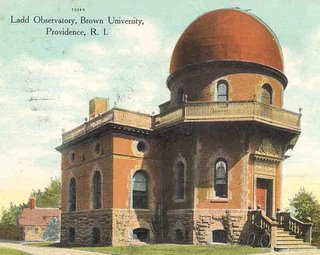
Does the ghost of Lovecraft haunt the observatory? Still in existence, still deeply loved and cherished, the Ladd Observatory was built the year after Lovecraft was born - constructed in 1891.

In a recent article [2] some interesting information has been related.

"Ladd was built to educate Brown students, to perform research and to serve the community. (The building was Providence's official time-keeping facility for years.) The observatory's first director, Prof. Winslow Upton, joined Brown University's faculty in 1884, on the condition that an observatory be built as soon as the funds could be raised. When the money had still not materialized five years later, Upton threatened he would go elsewhere unless immediate progress was made. Luckily for Brown, Herbert W. Ladd, then-governor of Rhode Island, offered to pay to build and equip the building that now bears his name. Because light and air pollution around the growing city of Providence {a top 10 city in those days - CP} soon made real discoveries impossible, Ladd remains a living museum of 19th century astronomy practices, complete with creaking staircases and a pleasantly musty attic smell." [2]

"Some of those rooms, like the one that houses the old transit telescopes, haven't been fully renovated. As the door creaks open, visitors are greeted by a blast of cold air. The lights don't work, but Targan shows groups around anyway, with the aid of a flashlight, pointing out how the telescopes were used to keep time by tracing the stars along the sky's meridian. In the dark, with various strange-looking contraptions covered in dark sheets, the building has a certain haunted house-quality, and indeed, Ladd is said to be haunted by at least one ghost -- that of noted Providence fantasy writer H.P. Lovecraft. "Did he ever come here?" a visitor asks. "Are you kidding?" Jackson says. "He had a key to the place." As a teenager, Lovecraft displayed a keen interest in the skies, even writing regular articles about astronomy for Providence newspapers. And he enjoyed the run of the observatory, thanks to then-director Winslow Upton, a friend of the Lovecraft family." [2]

"Ladd has its original copper-plated dome, which turns through a system of hand-cranked ropes and pulleys, and the original 15-foot refracting telescope that is controlled by a set of weights and gears, wound up like an grandfather clock. ... Ladd's first floor is an equally interesting and eccentric combination of attic and antique. Gas lamps still sit above the fireplace in the lecture room, where the shelves hold a variety of astronomical ephemera -- scientific journals dated from the 1970s, a globe or two, a Parade Magazine from last summer featuring Mars on the cover, an Edmund Scientific Star and Planet Locator. {as of 2004 -CP}" [2]

So, we're sure HPL haunts the observatory, but why would a professor let a boy have keys to a valuable observatory? After all, at only 15 years old, it was quite a valuable piece of real estate.

Chrispy has wondered for years, and been frustrated at the lack of information on Upton. However, certain anecdotes [3] survive and show the character of Upton. He was not the purely cynical scientist and had an altruistic spirit.

"Winslow Upton (1853-1914), professor of astronomy, was born in Salem, Massachusetts, on October 12, 1853. His father was a musician and young Winslow sang and took music lessons. After his graduation from the Phillips School in 1869 at an age his father considered too young for college, he continued his study of music and other academic subjects in Boston for two years before entering Brown in 1871. There he indulged his musical bent by setting the class roll call to music and composing a setting for Chaucer’s Prologue to be sung at the junior burial of books. [3]

"He shared his education with his sister Lucy {women had not yet been accepted to go to college and Brown was on the cutting edge of letting women go to college in the late 1890's - CP} by providing her with the books and outlines of the lectures for Professor Diman’s history course, which he then discussed with her in his letters. At Commencement in 1875 he delivered the valedictory address, Sympathy Essential to True Criticism. [3]

"He was employed for a short time at the Harvard College Observatory, going from there to the observatory of the University of Cincinnati {not far from Chrispy!}, and earning a master’s degree in 1877. From May 1878 to September 1879 he was a member of the staff of the Harvard Observatory, which experience was the inspiration for a skit, The Observatory Pinafore, (obviously a parody on a Gilbert and Sullivan operetta), which included such lines as:

I’m called an astronomer, skillful astronomer,
Though I could never tell why;
But yet an astronomer, happy astronomer,
Modest astronomer, I.
I read the thermometers, break the photometers,
Mend them with paper and wax;
I often lament that so seldom is spent
A fair evening on star parallax.
" [3]


"After a short stint in Detroit with the Army Engineer Corps’ Lake Survey, Upton became a computer {a person who does copious quantities of math - CP} at the Naval Observatory in Washington in 1880. He worked with the United States Signal Office from 1881 to 1883. In
May of 1883 he accompanied a group of scientists to Carolina Island in the Pacific to view a solar eclipse, an event which resulted in his writing The Carolina Island Opera. In September of the same year he came to Brown, having been encouraged by President Robinson’s assurance of an
observatory in the near future, to take a position which included teaching mathematics and logic. A few years later he was inclined to leave when the promised observatory had not materialized {see above notes, [2] - CP}" [3]
"Upton took a leave of absence in the academic year 1886-87, during which he spent six months in Germany, two months in England, and visited leading European observatories. He observed
the total solar eclipse of August 19, 1887 from the interior of Russia. He was away again in 1896-97 at the southern station of the Harvard College Observatory in Arequipa, Peru. During this time he conducted a special series of observations from Arica, Chile, and made four ascents of the volcano El Misti, which was the site of recording instruments maintained by Harvard and the highest meteorological station in the world." [3]

"He was appointed the first dean of the University in 1900, but resigned that position a year later. President Faunce, speaking of this time, said, 'For one year he was Dean, and I was brought into contact with him more than ever. But his nervous system was too delicately organized for the position and at the end of the year he wished to give it up. The burden of
every man was his burden, the disappointments of others were his disappointments. The tenderness of his heart was something which only those who came into close touch with him can know.' [3]
"In December 1913, after directing the Christmas music performed by his church choir, he
became ill with pneumonia and died on January 8, 1914." [3]
I think what is telling is the passion that Upton had for people. In 1900, Lovecraft was 10. As Dean he would have had to solicit money - a usual prerequisite to fund projects - and no doubt aquainted himself at least by then with one of the richest men in Providence - Lovecraft's grandfather. Imagine the stories HPL heard from Upton.
A household filled with women, a veritable matriarchy at the time, Upton would have been sympathetic to the precocious child who was already translating Latin, knew the classics, read Scientific American with a passion, and had the financing to be anything he wished. HPL would ahve been into the violin by then, another (musical) touchstone. By winter 1902, all young Howard could think about was astronomy. [4]
I believe we can make some assumptions. Upton was compassionate, gregarious, and perhaps saw a kindred soul in a precocious child. Himself a prodigy, held off from attending college, dominated by a strong male figure, how could Upton miss the cues?
One thing I've learned about HPL is that he was a cautious, deliberate spin doctor when he wrote letters and stories., revelaing only what he wished to reveal. The reality is that Howard was a typical geeky child who worshiped the then-in-vogue Scientist-Explorers. In his house, a living breathing Victorian Adventurer appeared and Howard fell deeply into idolatry - at least until the chemist Appleton appeared in the midst.
Still, it was astronomy that was a passion, and Upton left his greatest legacy embedded into the bosom of H. P. Lovecraft.


1 Chrispy now owns this eldritch postcard. Complete with a 1 cent stamp :) it is dated July 9, 1909 when Lovecraft would have neared his nineteenth birthday and was deep in the realization that he would never be a true astronomer. Between 1908 and 1914, HPL discontinued writing his astronomy columns and most writing of any kind. He wrote one letter to the Providence Sunday Journal on a minor stir he noted. Some pasers-by began to idly speculate that an "aeroplane" was on the horizon. HPL, flabbergasted, lectured the crows that it was merely the planet Venus. So appalled, he wrote the newspaper and lamblasted the ignorance of the public. Collected Essays, Vol. 3, Science, Joshi, 2005, Hippocampus, pp. 99,100

2 Article on the web. http://physics.brown.edu/ physics/ newspages/ Projo-Ladd-Article.html
3 The above quotes appear in Encyclopedia Brunoniana by Martha Mitchell, copyright ©1993 by the Brown University Library and are used only to elucidate the scholarly thesis I present.
4 A Dreamer and a Visionary, Joshi, p. 44

Friday, April 07, 2006

Lovecraft's Scientific Heroes


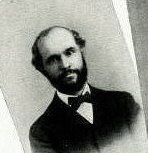
Winslow Upton c. 1899
Renowned astronomer. Brown had to build the Ladd Observatory to keep him on staff.


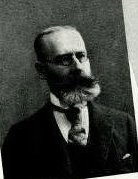
Renowned chemist, John Howard Appleton.

Gave HPL one of his first chemistry books.

Chrispy has a copy and has posted excerpts throughout the blog.

Saturday, January 28, 2006

Lovecraft the Chemist

One of the reason's Chris reads Lovecraft is because of the chemistry HPL sneaks into his stories. [Chris is a chemist in "real" life.] I came to Lovecraft very late, only about 5 years ago. I'd remembered him - vaguely - from high school converstaing, but in those days it was all science fiction and no horror.

Once obsessed, an HPL fan knows no bounds. One of my treasures is my copy of The Young Chemist, John Howard Appleton, Silver Burdett & Co, 8th ed., 1889!

"In 1899 a new interest of mine began to gain ascendency... a love of chemistry ... a friend of ours is Prof. John Howard Appleton, the venerable professor of chemistry at Brown {University} & author of many books on the subject." [1, p. 71]

"The science of chemistry first captivated me in the Year of Our Lord 1898 ... in ... Webster's Dictionary ... chemical appartus especially attracted me ... being a "spoiled" child I had but ask ... I was given a cellar room ... some simple apparatus & a copy of "The Young Chemist" - a beginner's manual by Prof. Howard Appleton of Brown - a personal acquaintance." [2, p. 38]


Well, one day I was reading his and Hazel Heald's [3] story Winged Death. This is usually panned by all critics, but happens to be a favorite of mine - about a tse tse fly of all things.

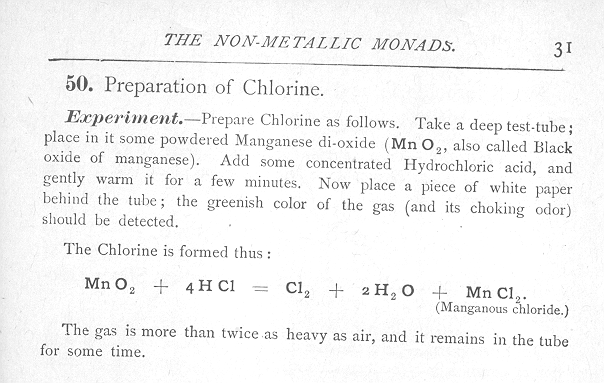
I came across "...both chemicals - hydrochloric acid and manganese dioxide - on the table all ready to mix...". Hmm, I say to myself, Chris! you've seen that somewhere. Indeed. When I flipped open Appleton's book, there it was, virtually word for word. The story was written between 1932-1933 and mostly by HPL. At age 43, Lovecraft still either had his little, precious book, or had recalled it after decades. Truly, HPL was a remarkable man.


1 {Nov 16, 1916} H. P. Lovecraft: Letters to Rheinheart Kleiner, op.cit.
2 {Aug 29, 1918} H. P. Lovecraft" Letters to Alfred Galpin, op. cit.
3 Winged Death, c. 1933, Hazel Heald, H. P. Lovecraft: The Horror in the Museum and other revisions, Carroll & Graff, 2002, pp. 146-167.


Note: If you like Gilbert and Sullivan, and like it mangled, read my latest parody ... Member of the Menagerie by Giblet and Skeleton - Here!

Followers

Blog Archive

Facebook:

Google Analytics